Kenian Girl Shows me Nairobi for a Day
Welcome to Nairobi, the "Green City in the Sun." The name itself comes from the Maasai phrase Enkare Nairobi, meaning "place of cool waters," and the city has been growing almost without pause since it was founded as a colonial railway settlement in 1899.
Today it is home to over 5 million people, one of the fastest-growing cities in Africa, the headquarters of the UN Environment Programme, and a city that somehow contains a national park with lions inside its own boundaries. It is a city of enormous contrasts, enormous energy, and genuinely enormous surprises.
I was only supposed to be here for 3 days but ended up staying for over a week. That tells you everything you need to know.
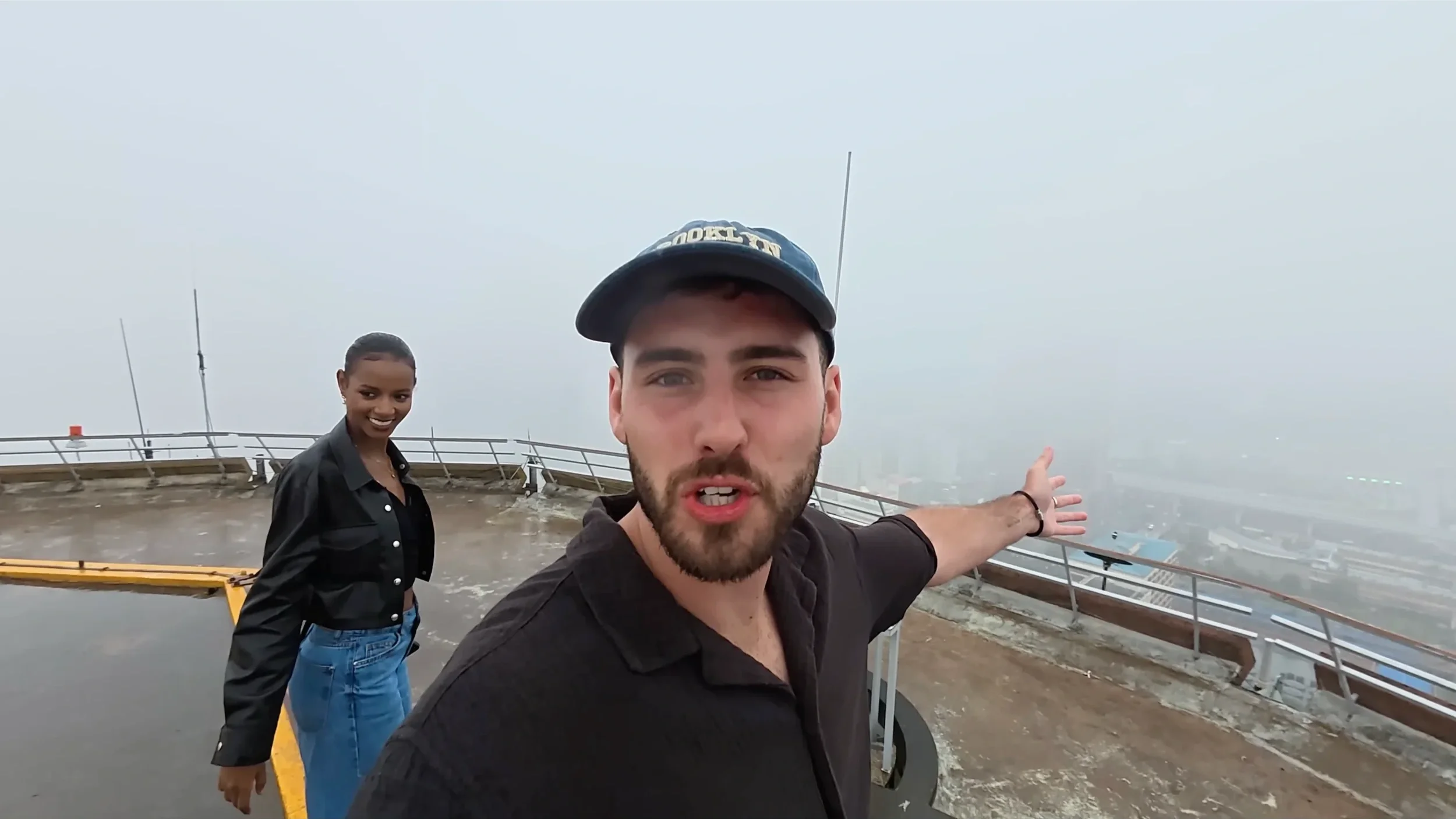
My Kenyan friend Sadia offered to take me around for a day and show me a side of the city most visitors never get to see. We started at the top of the KICC helipad, one of the best vantage points in Nairobi. The weather was not cooperating. Rainy and a bit foggy, the city sitting under a grey blanket of cloud, which was not ideal given we had planned a helicopter ride for later. We were up there anyway, looking out over the Parliament building, the immigration offices, the old Kerry Centre where Sadia's dad worked for years.
Then she pointed to a building and mentioned, almost casually, that the space next to it was where the 1998 al-Qaeda bombing happened. The US Embassy. Over 200 people killed. There is a lot of dark history in this city that I had absolutely no idea about before coming here.
From the helipad you can see Uhuru Park below, a large stretch of green right in the middle of the city where people come to picnic, run events, and just exist. Sadia told me there was once a plan to build on it. A woman named Wangari Maathai fought to stop it, got beaten up for it, and took on the president himself. The park is still there because of her.
Sadia also mentioned that last week was the one-year anniversary of the Gen Z protests. More people were lost. The CBD was a mess. Businesses destroyed. She said it the way you talk about something that still hurts but that you have had to make peace with. Most of Kenya's population is young, and according to Sadia, Kenyans are educated and they are not going to be messed with.
On the way down from the helipad, she told me she went to boarding school for 4 years because she was a naughty child. No real showers, just buckets. She had to lock her bucket to the washing lines because someone would steal it otherwise. The school rule was that students had to run everywhere. Movement by running, MBR. If a prefect caught you walking, you knelt on the spot. If a teacher walked past, you got sent back to class. Illness was not accepted as an excuse.
Feeding a Giraffe With My Mouth
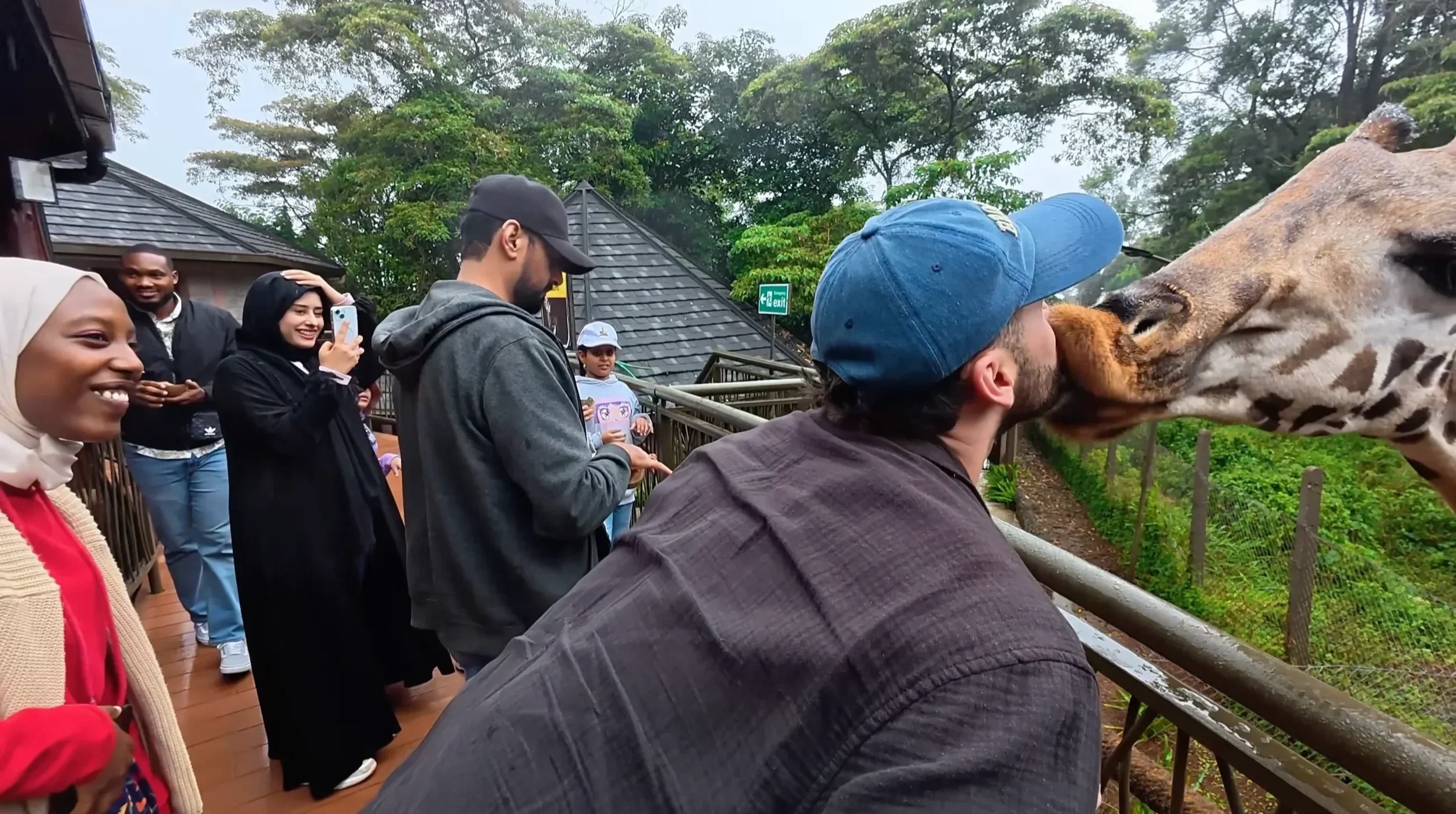
First stop of the day was the giraffe centre. Before entering you wash your hands, get a bowl of pellets, and feed the giraffes one at a time on their tongue. No open palm, no tipping the whole bowl in, and definitely no getting too close because apparently they headbutt when they are angry.
Sadia told me that when she was younger she used to feed them with her mouth. Not allowed, obviously, but you can get away with it once or twice if you are quick about it, so she challenged me. The technique is straightforward enough: hold the pellet between your lips, lean toward the giraffe, and they will see it and take it. And so I tried.
Getting the giraffe's attention was harder than expected since I was not the only one feeding her, and I had to compete for her focus for a few minutes before she finally looked my way. When she did, I leaned in, ready for a clean, dignified exchange between man and animal. What happened instead was a full, unrequested, deeply committed French kiss. Her tongue was everywhere. It was enormous. It was warm. It lasted longer than any social interaction I had prepared for that morning and I can only describe it as one of the most viscerally unpleasant experiences that also produced an excellent photo.
The giraffe's name was Salma. 13 years old, and when you called her name she actually turned around, which somehow made the whole thing feel more like a failed date than a zoo visit.
There was also a warthog wandering around below. Possibly the ugliest animal I have ever seen up close.
Sadia mentioned that sometimes you can still see giraffes wandering around Nairobi. Not just in the park. Out in the city. That is the kind of sentence that makes you realise how genuinely different this place is from anywhere else you have been.
Robots aren’t Taking Over Anytime Soon
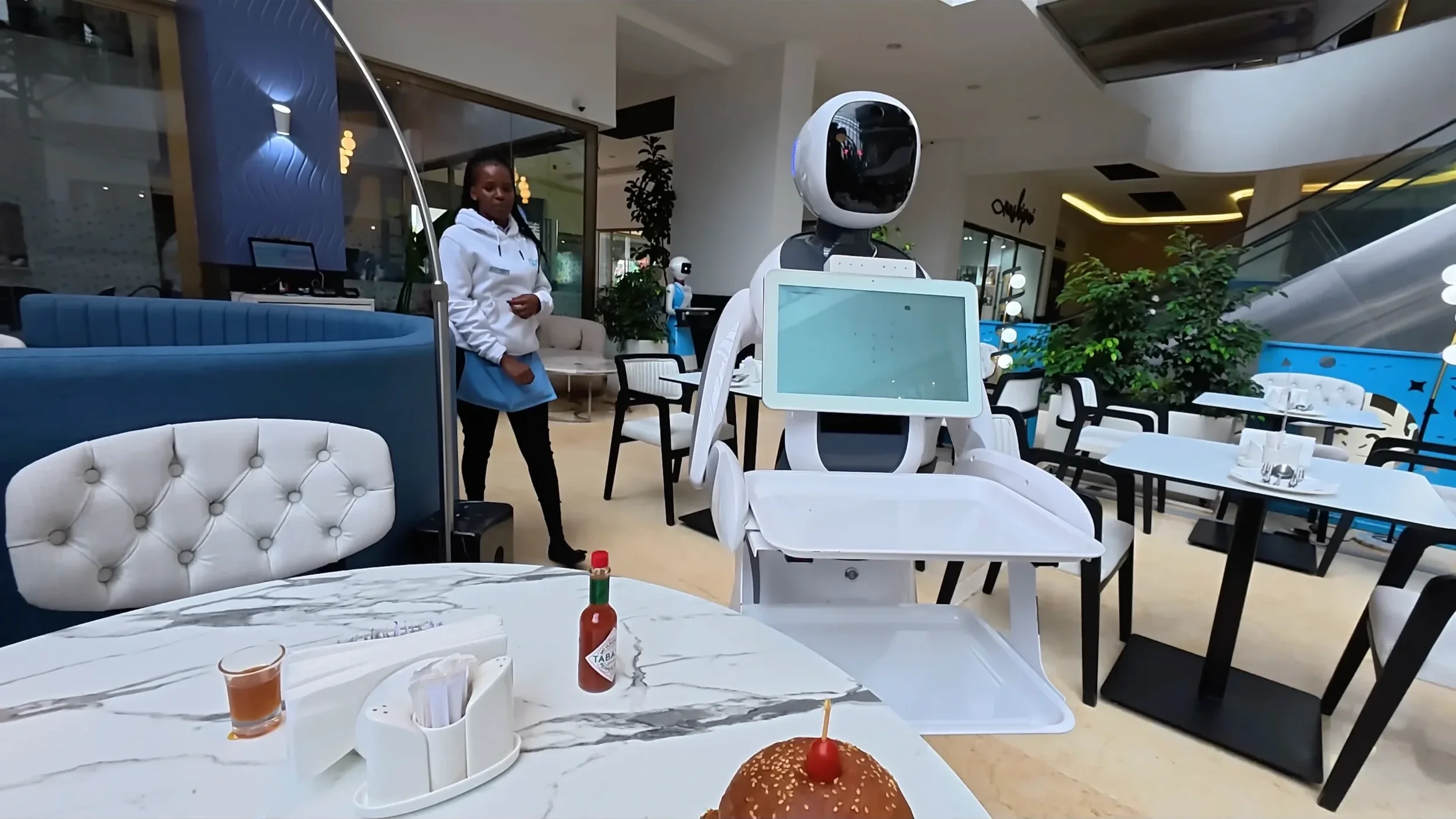
After the giraffe centre we went to a café where robots deliver your food. A human waiter still takes your order at the table, but then a small robot comes out and brings everything to you. In theory.
In practice, the robot got stuck. Multiple times. There was a screen on it that at one point just read "unable to walk." Staff members had to physically push it in the right direction. It also told us the food was going cold while it sat there unable to move, which felt like a passive-aggressive touch that nobody had asked for, and reminded us to leave a Google review before returning to the kitchen. Genuinely.
I ordered the chicken burger. Sadia got the beef shazwan. The food was actually good. The chicken burger was enormous, mushroom sauce dripping everywhere, and Sadia's dish had a smokiness to it that made up for the slightly chewy meat.
Overall verdict: good food, questionable robot concept. Sadia put it best when she said that in China they pulled this off properly. Here it needed a bit of work.
Total bill came to around 1,500 Kenyan shillings, roughly $11, which is all I needed to forgive a stuck robot.
Drinks Above the National Park
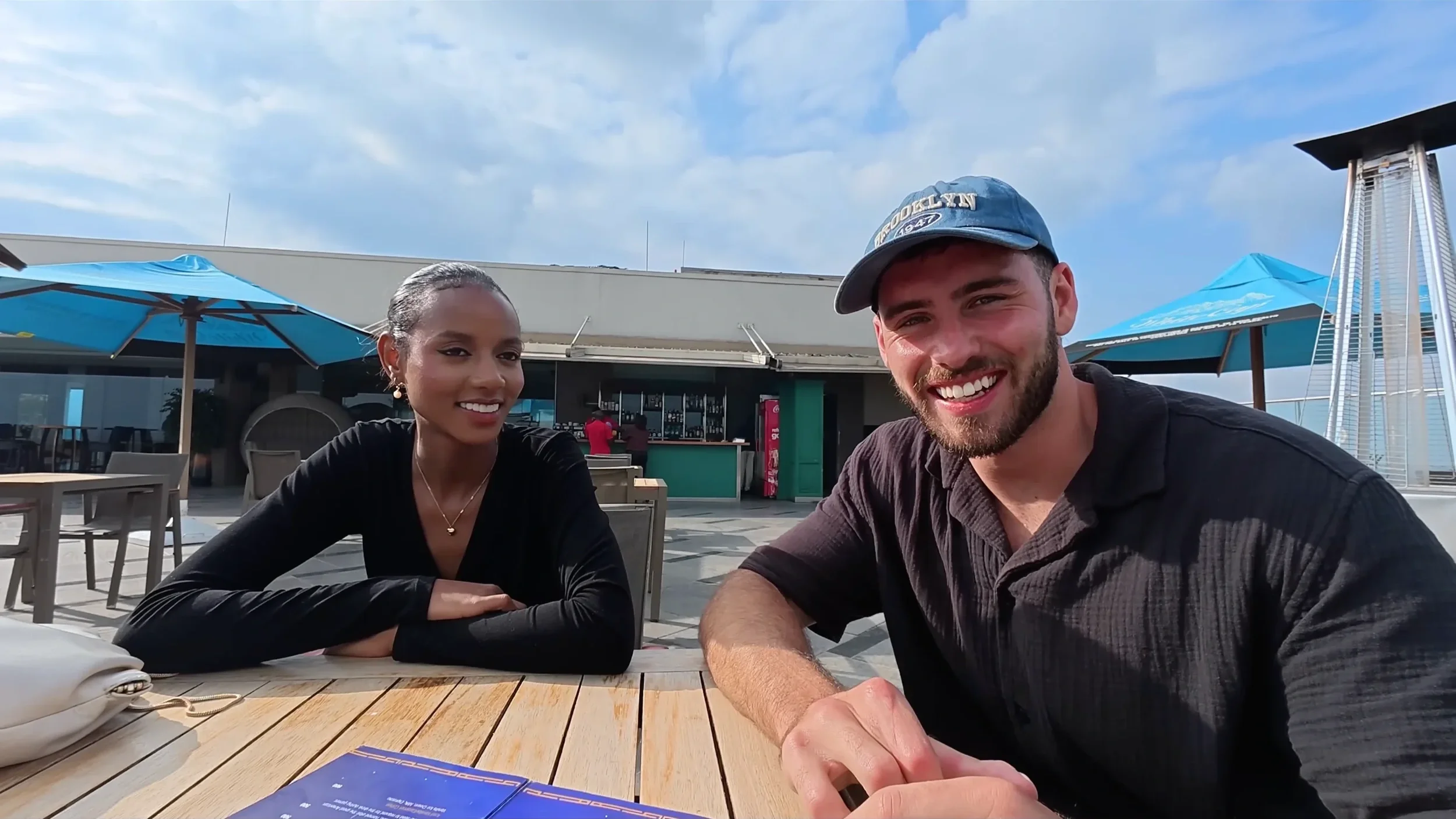
After lunch we went to Emara, a hotel overlooking Nairobi National Park, and the weather that had been miserable all morning finally broke. Sun came out. We got a table on the rooftop with a direct view over the park.
Nairobi National Park is the only national park in the world located inside a city. You can sometimes see lions with skyscrapers behind them. There are photos of it. I have now seen the view with my own eyes and still find it hard to process as a concept.
Sadia mentioned an event called Gondana, a big DJ night that happens there. Best DJs, sunset views, tables reserved weeks in advance. She also told me about parties held inside the national park itself, and inside an old abandoned railway station where they put a DJ on the train. Nairobi nightlife operates on the principle that if somewhere looks interesting, you turn it into a party.
We had drinks for about 1,500 shillings ($11) between us and the national park view was included.
Flying over Nairobi
After the drinks came the best part of the day: a helicopter ride over the city. The cost was around $1,500 (USD) for an hour's flight over Nairobi, just the two of us and the pilot, departing from Wilson Airport where all the safari planes operate out of. The weather, which had been awful all morning and started to clear while we were at the national park bar, was fully clear by the time we walked out to the aircraft.
Safety briefing at the helicopter: "avoid the tail." That was it.
No demonstration. No pamphlet. I could have very easily lost a finger and nobody would have technically been at fault. The headsets we put on did not connect to the pilot at all. Instead we got continuous air traffic control radio from somewhere, which was disorienting and informative in equal measure.
And then we took off.
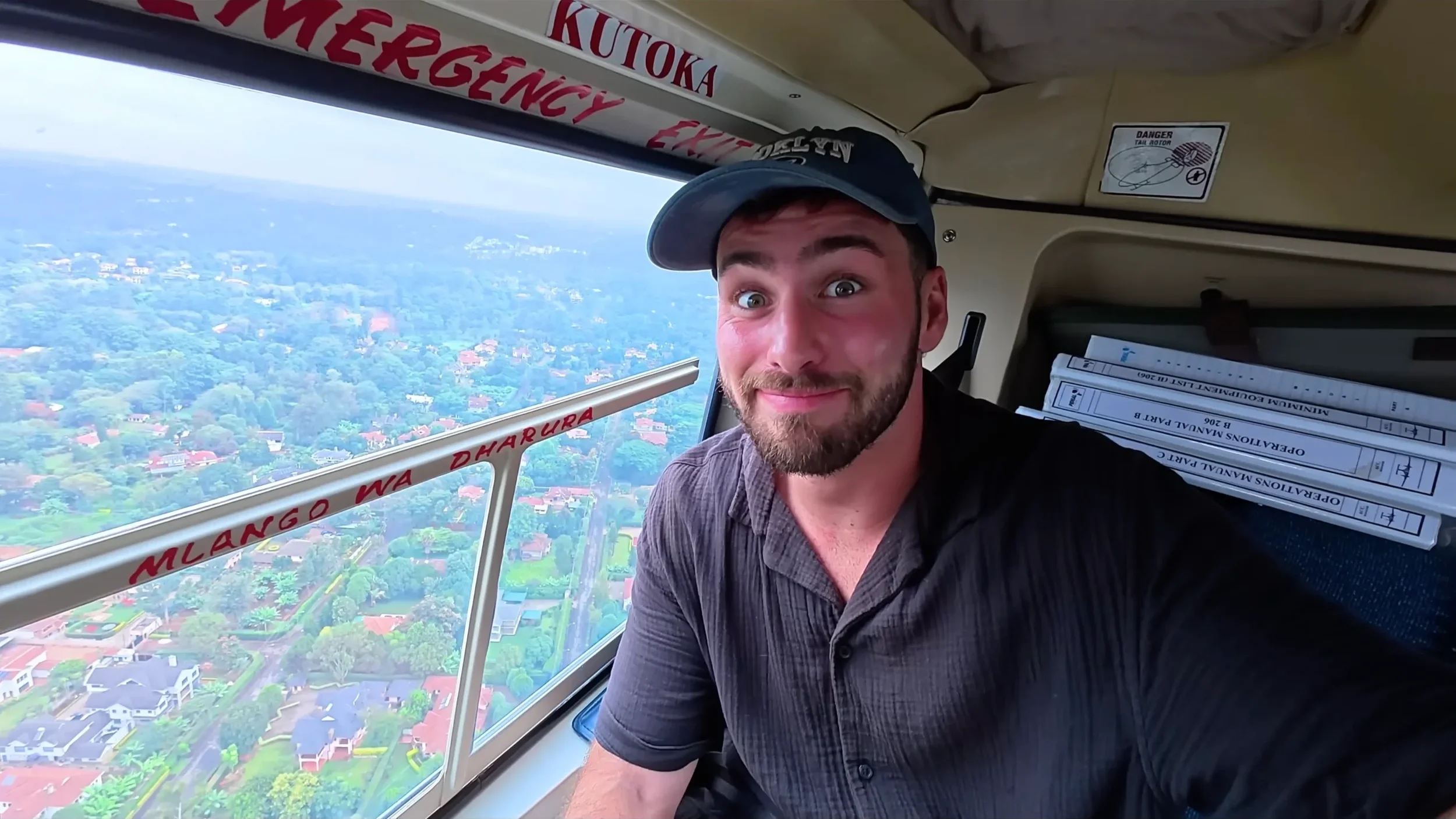
What you see from up there is a proper contrast. On one side, large houses, gardens, and nice suburbs. On the other side, thousands of tin shacks made of mud and wood. Kibera, the largest urban slum in Africa, home to somewhere between 500,000 and 1 million people depending on who you ask, all packed into about 2.5 square kilometres, sitting right next to the CBD skyline. The inequality is not subtle from the air. It is the first thing you see.
We flew over the prison. The stadium. The green that goes on forever past the edges of the city. At one point the full city was just a distant line of buildings surrounded by jungle in every direction.
Sadia said from up there it looked organised. And she was right, in a way. There is a logic to the layout when you see it from above: slums, forest, apartments, CBD, houses. Everything in its zone. The city is functional and it is growing. The inequality is obvious but so is the momentum.
Coming back down, I thought about how much I had underestimated Nairobi before arriving.
Crocodile and Ostrich Meat at Carnivore Restaurant
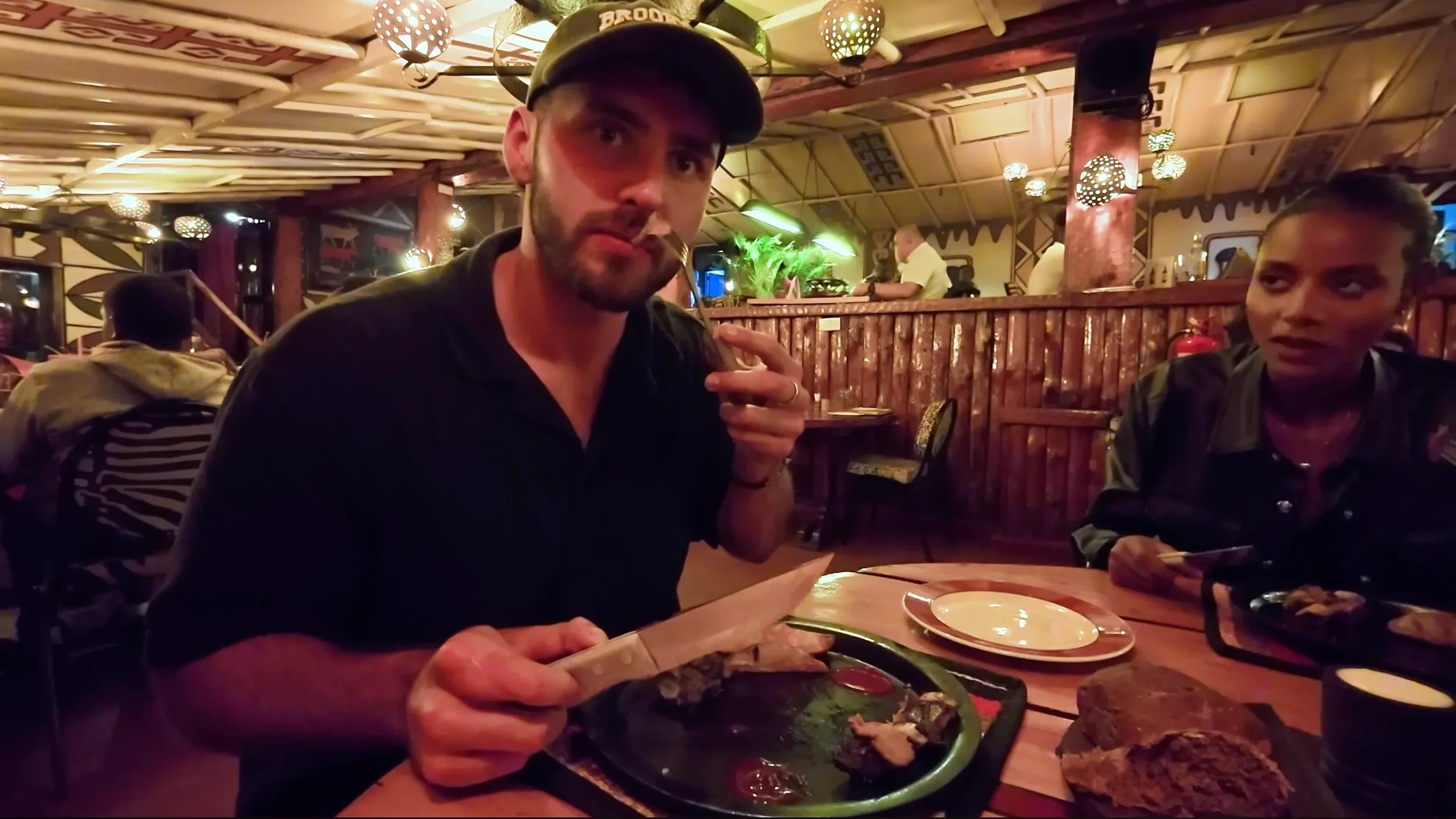
By the time we landed it was time for dinner, so we headed to Carnivore, which is essentially the only place in Nairobi where you can eat exotic meat. The concept is straightforward: fixed menu, all you can eat, servers come around with different meats on skewers until you surrender. You signal surrender by lowering a small flag on your table.
They had fox, chicken, lamb, sausages, turkey, beef ribs, ostrich and crocodile, all cooked over an enormous open coal grill at the entrance that is genuinely one of the most dramatic things I have ever seen inside a restaurant.
Sadia used to come here as a kid. She said it used to have a playground. Now it has an extensive sauce pairing system. Garlic goes with crocodile. Wild berry goes with ostrich. These are not arbitrary suggestions.
We started with the beef ribs. Smoky, tender, solid baseline. Then ostrich, specifically the leg and also in meatball form. The meatball was better than the leg and honestly better than most things I ate that day. Soft in a way I did not expect, and I would order it again without hesitation.
Then the crocodile. Mixed cuts, garlic sauce. A bit chewy. Not fishy at all, which surprised me. Sadia gave it an 8 out of 10. I got an unlucky chewy piece and could not be quite as generous.
Sadia made the observation that as long as Carnivore is open, at least one crocodile has to die every single day to keep the menu going. We briefly considered becoming vegetarian. Then Patrick came around with another round of ostrich meatballs and that conversation ended.
Earlier Sadia had mentioned it was her birthday the following day, so I had quietly arranged a birthday cake when making the reservation. What I did not fully anticipate was the entire restaurant staff forming a procession around the table and performing what I can only describe as a full ceremony. Around 10 to 15 of them, singing happy birthday first in English and then in Swahili, "Heri ya Siku ya Kuzaliwa," the same melody but in a completely different world. It felt like being in the middle of the Lion King’s live theatre performance. Sadia did not expect it at all and was genuinely delighted.
After dinner, Sadia took me somewhere I was not expecting. Back to the playground she used to come to as a kid, and it was still there. Same swings. Same spot. Roughly 13 years since she had last been. She stood there and remembered the blisters from the rings. Her mum telling her off for it. How enormous everything had felt when she was small, and how this thing she remembered as vast was now just a normal park.
It was a good way to end the day.
Final Thoughts
I went to Nairobi expecting to stay 3 days and at the time of this particular day out it had already been nearly a week. I still have not fully figured out why it does that to people, but I am starting to understand it. This city has history, contrast, nightlife, wildlife, food, chaos, and warmth all stacked on top of each other. It does not let you feel neutral about it.
Nairobi, I will definitely come back.
-
Need an eSIM when you travel? Check out Globie eSim →
Want daily emails from me? Sign up here →