I Spent a Day Inside Kibera, Africa's Largest Slum
Nairobi hits you before you are ready for it. The city is loud and fast and full of contradictions, a skyline of glass towers and corporate billboards sitting about 7 kilometres away from one of the most densely populated places on earth. Around 60% of Nairobi's population lives in informal settlements, crammed into just 6% of the city's land. That number takes a moment to actually process.
The one everyone talks about is Kibera. Somewhere between 500,000 and over a million people, depending on who you ask, living in an area roughly the size of Central Park. The Kenyan government owns all the land. Most residents have no legal claim to where they sleep. The name itself comes from a Nubian word meaning forest, which is what it was before it became this.
I had no plan walking into this one. No guide booked. No itinerary. Just a rough idea that I wanted to get into Kibera and see what was actually there. Whether the people were friendly. Whether kindness exists in a place experiencing some of the worst poverty on the planet.
Spoiler: it does. But we will get to that.
50 Shillings Gets You to the Edge of Kibera

Nairobi is a big city and Kibera is inside it, which sounds simple until you are standing on the street trying to figure out which of the dozens of minibuses with hand-scrawled signs goes where. I ask around and someone points me to number 8.50 shillings ($0.39). About 30 minutes. Pay after.
The buses here are called Matatus and they are the lifeblood of Kenyan transport. Little buses packed with people, weaving through the city, going everywhere. Mine fills up fast and we are off. I sit in the back sweating before we have even left the stop.
The ride is exactly what you would expect if you have never been on a matatu before and nothing like what you would expect if you have. The driver treats the concept of lanes as more of a suggestion, the music is louder than any speaker that size should legally produce, and at one point we stop in what appears to be the middle of a roundabout to let someone off.
Nobody reacts. This is normal. We are flying through Nairobi at a speed that would make a reasonable person nervous and somehow the whole thing feels completely fine, right up until the moment it stops and someone points at a door and indicates that this is is my stop.
I step off just outside Kibera and realise I still have to find my way in. The entrance is not obvious. There is no sign. There is just a gradual shift where the road changes and the buildings get closer together and the noise changes character.
But before going any further, I decide it was a good idea to grab a bite at a local spot nearby.
My First Meal in the Slums
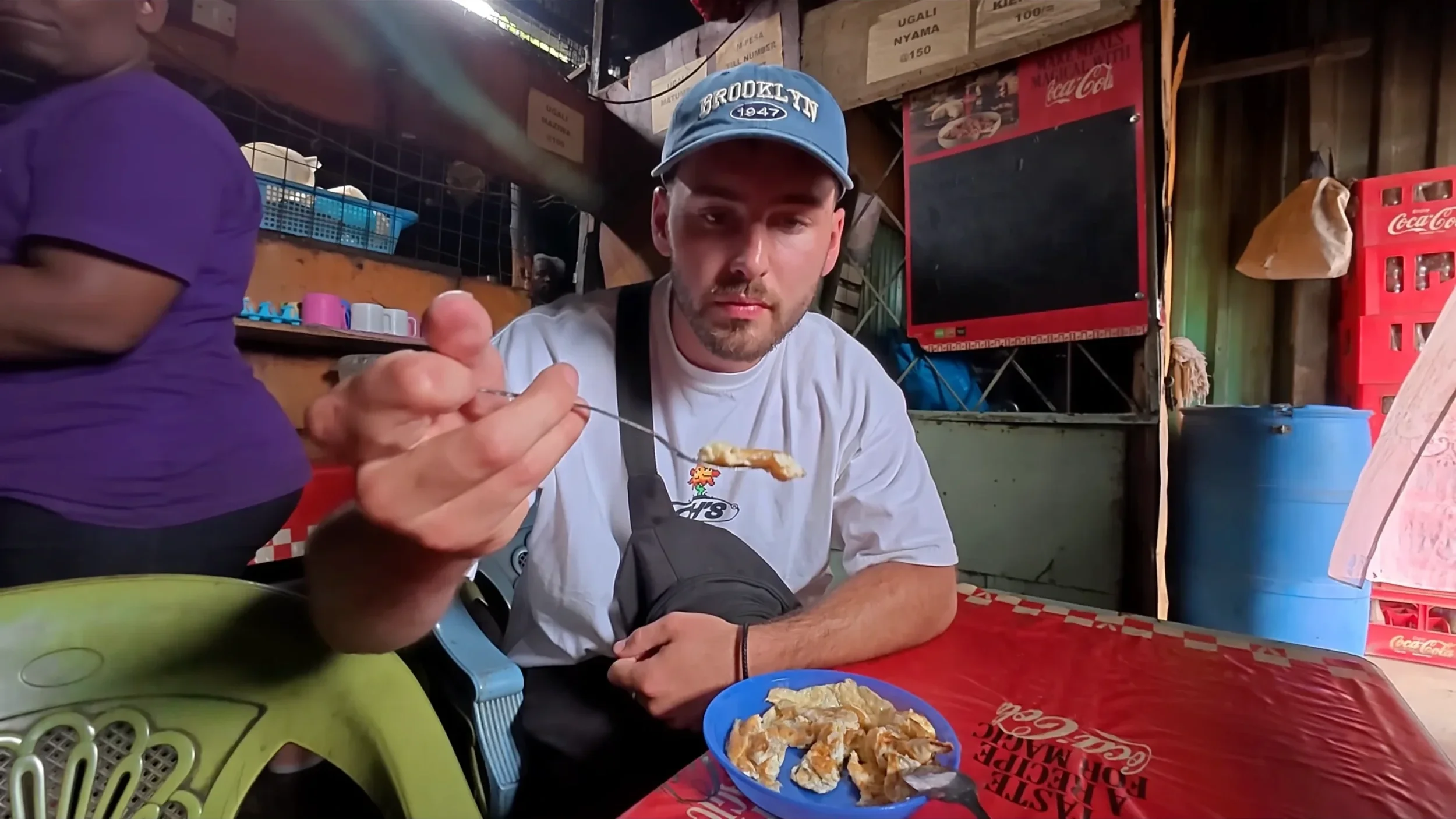
Like I said, first order of business was food. Someone and they point me to Tazama Hotel, which is less hotel and more a small local kitchen where you can get a fried egg omelette for 70 shillings ($0.54). That is about 27 cents an egg. The lady running it is called Grace.
I said kitchen, but what I mean is a shack with 4 walls, dirty pans hanging on nails, a small gas burner doing serious work, and a chicken walking around the floor like it owns the place. It was brilliant. I only order 2 eggs because I am still trying to ease myself into things, still finding my feet, and also because there is a chicken watching me and I do not want to make it awkward.
I eat quickly and ask some of the locals also eating there how to get deeper into Kibera and they point me toward Olympic Primary School. But once outside I spot some boda boda drivers waiting around, which are motorcycle taxis common all over East Africa, and I decide that is a faster option. The driver is called Patrick and for 200 shillings ($1.55) he agrees to take me deeper into the slums.
One thing I notice immediately: Kibera has more infrastructure than people expect. Gas stations. Electronic shops. Medical clinics. Primary schools. It is not a wasteland. It is a functioning community that has been underserved, not abandoned entirely. That distinction matters.
Walking the Railway Tracks Into the Heart of Kibera
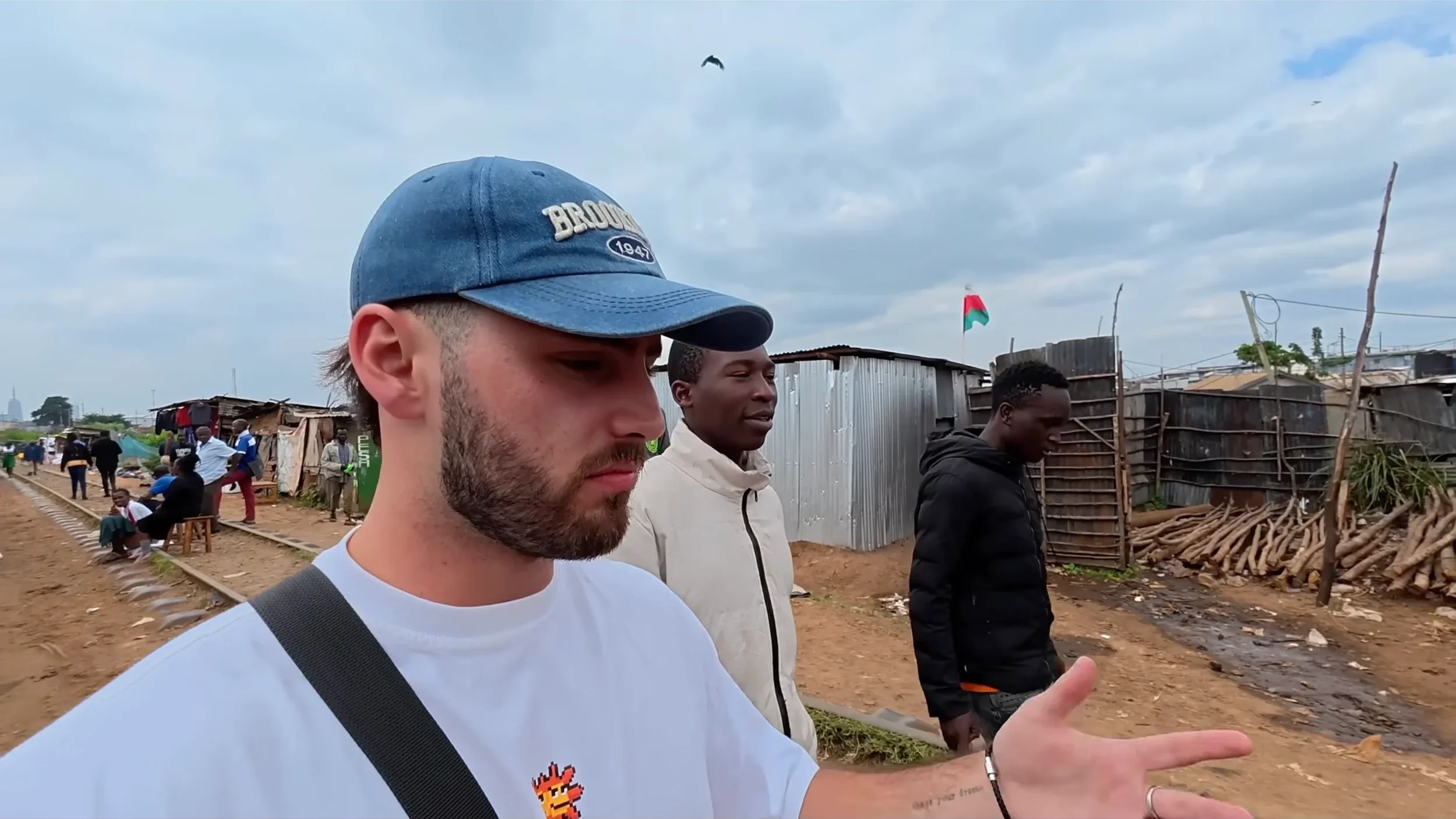
Patrick drops me near the railway tracks that cut straight through Kibera and that is where I get my first proper look at the place. Homes made of mud, sticks, and corrugated tin packed in tightly on both sides. Clothes drying on lines strung between anything that will hold them. People just getting on with their day. A guy selling phone cases next to a pile of rubble. Someone cooking something that smells better than it has any right to given the circumstances.
I have no plan so I start walking down the tracks.
Within a few minutes I meet Jar and his mate, 21 and 20, both from Kibera, both genuinely curious about what an Australian is doing wandering around with a camera. We talk about what day to day life actually looks like here. Chilling with mates. Football. Trying to build something out of nothing. The usual stuff, just with a very different backdrop.
One of them makes music. He plays me a track about a place they call Scottish, their chill-out zone, a little pocket inside Kibera where his crew hangs out. I have no idea at that point that I am going to end up there by the end of the day.
This is where the day starts getting interesting. Jar takes me to a printing shop run by a guy named Kevin. Custom t-shirts, made right there in the slum. They convince me to get one printed with the Scottish logo on it, but there is no electricity at the time, which means my shirt will not be ready for a few hours. Kevin says he will sort it and call when it is done. 1,000 shillings ($7.75). I do not pick a colour. I tell him to surprise me.
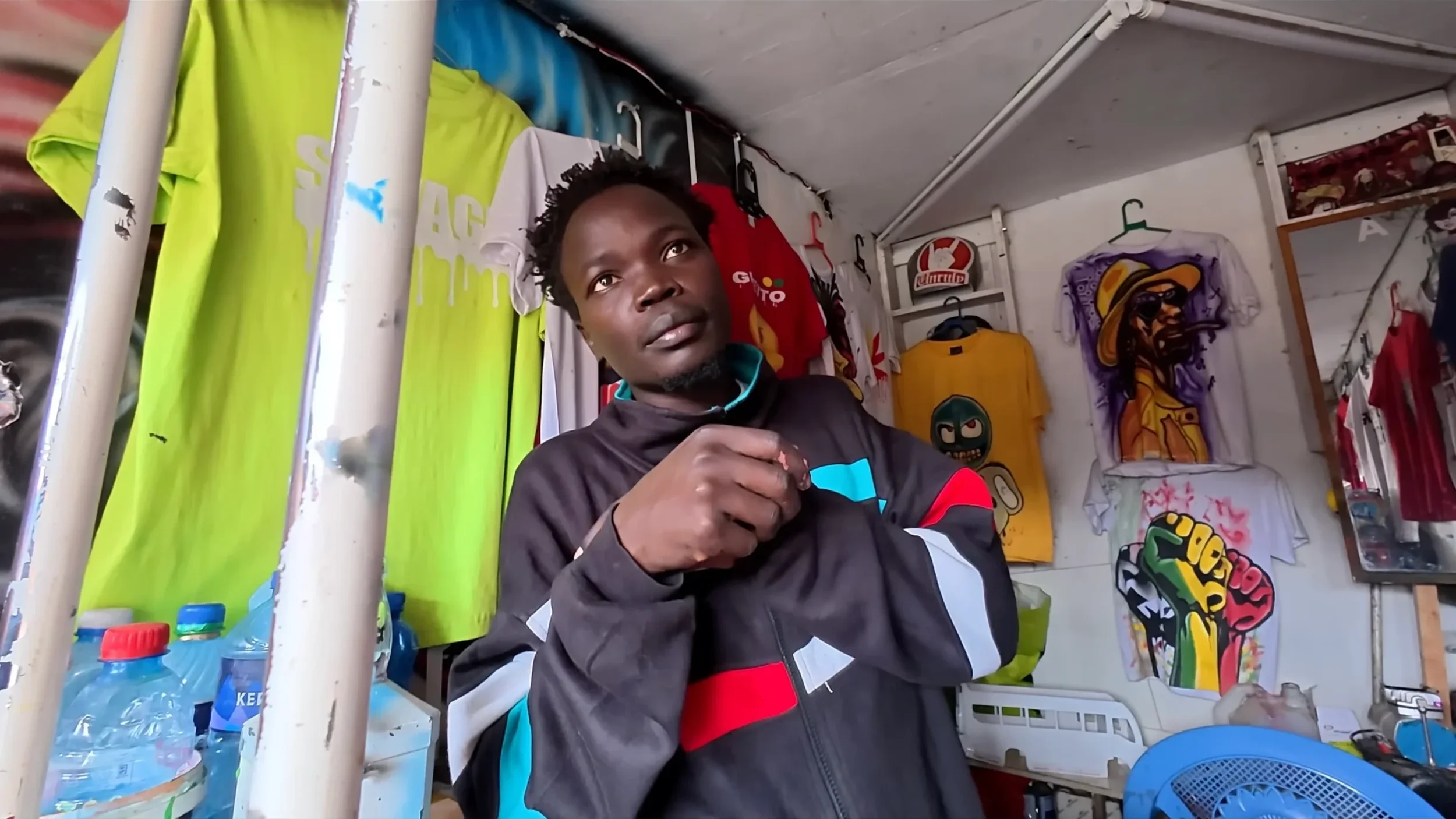
Then I meet Brian. He is a stand-up comedian who happens to be there, and I ask him to roast me on camera. He does not hesitate, not even a little bit, and the next two minutes are genuinely not easy viewing for me personally.
Then Brian switches gears entirely and talks about what it is actually like growing up in Kibera as a young man with ambition. The emotional and physical weight of it. Having dreams and goals but no financial support, families who do not believe in you, and a government that responds to that reality by taxing more and harassing more rather than doing anything to help talent grow. He says it clearly and without a trace of self-pity, which somehow makes it hit harder.
I do not have much to add to that. I just listen.
Exploring the Slums with the boys
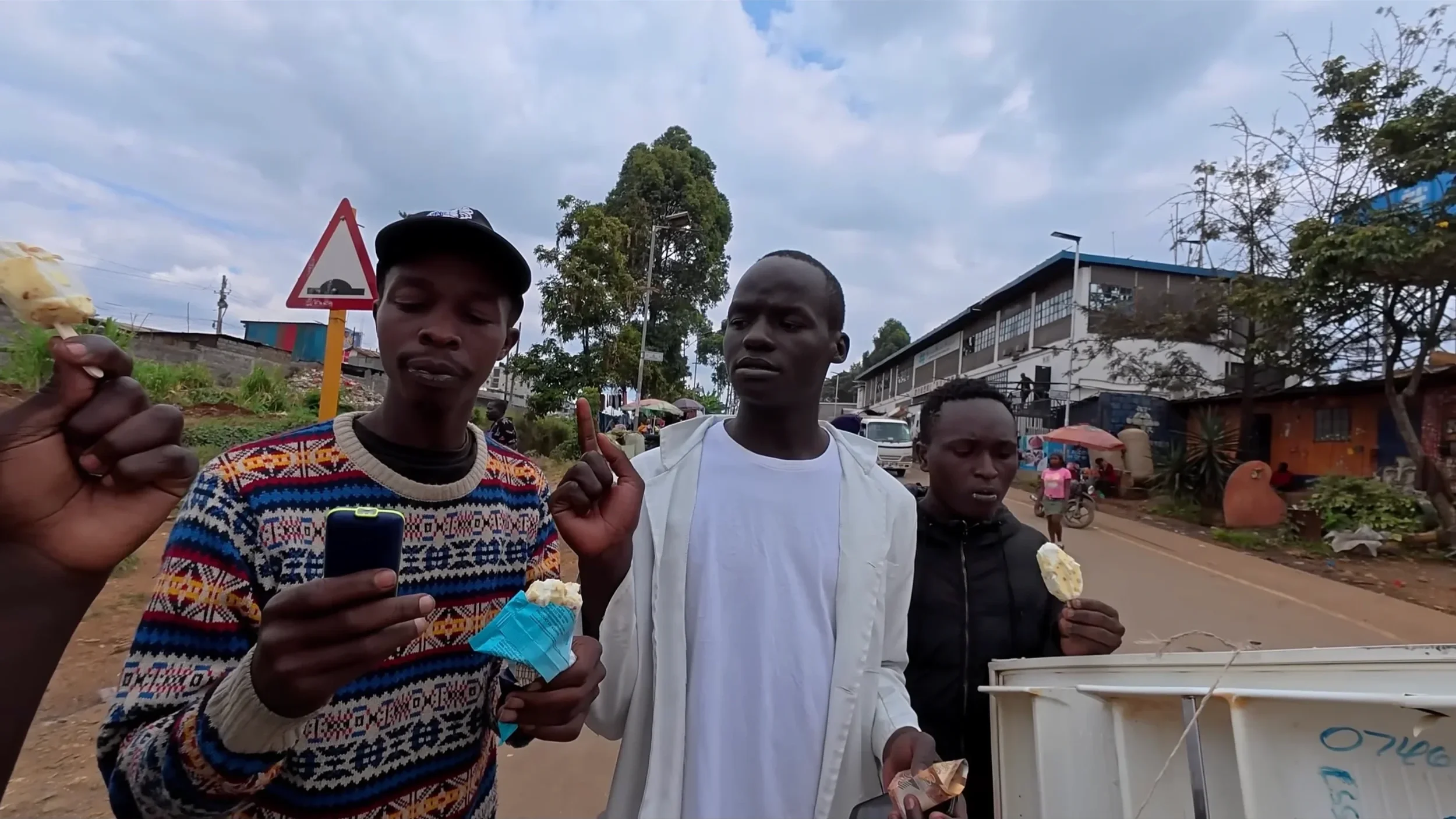
After chatting for a bit, Jar and his mate decide to take the day off, not like they had much on anyway, and show me around the slums. A few minutes into the walk we bump into an ice cream seller, and as a Luke Damant classic, I buy ice cream for everyone, including the random guy who just happened to be walking past at the right moment. Five at 50 shillings ($0.39) each, plus a 150-shilling ($1.16) magnum looking like ice cream for me because I have standards. There is a whole maths situation at payment involving change, competing counts, and a final number that takes about 4 people to agree on. Luckily I am good with numbers so I sort it out.
After the ice cream I feel the urge for a cigarette, except I have been trying hard to quit smoking, so instead I introduce the boys to Zyn, the nicotine pouch. They are curious. I explain that you just put it under your lip and leave it. They compare it to chavis, their word for chewing tobacco, and agree it is a similar energy in a different format. One of them passes. The rest give it a go.
Then comes the khat. Khat, or jaba as they call it here, is a plant native to East Africa and the Arabian Peninsula that has been chewed for centuries as a mild stimulant. It is completely legal in Kenya, sold openly at little stalls in small bags, and the leaves give you a slow-building alertness that apparently keeps you going for hours. On its own it is quite sour, so the trick is to chew it with bubble gum to balance out the taste, which is exactly what we do. One bag costs 200 shillings ($1.55).
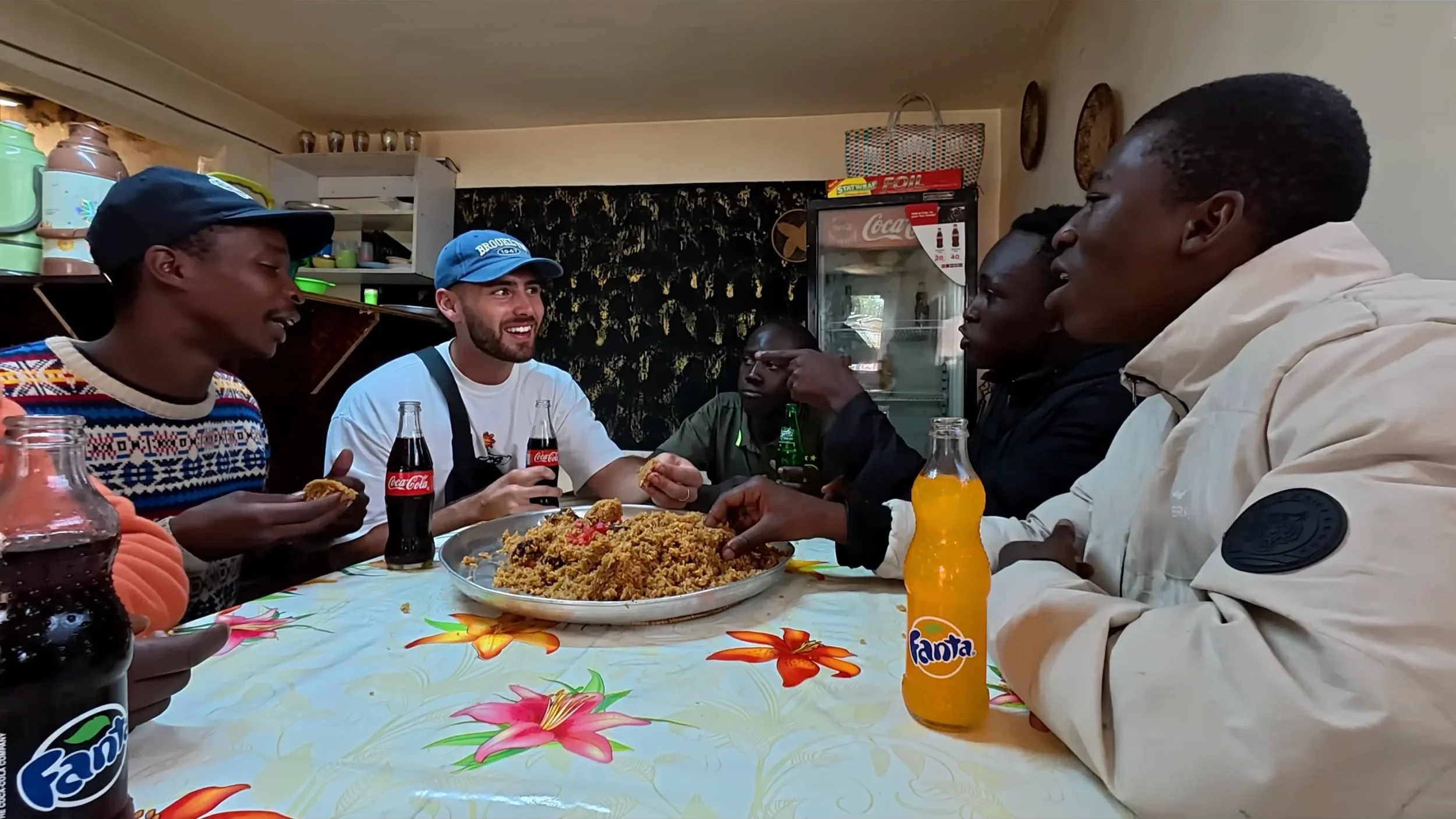
Before the khat though, we sit down for a proper meal. The boys take me to a Nubian restaurant. The Nubian people are one of many distinct cultural groups living inside Kibera, with their own marriage traditions, burial rites, and food. The dish they order for me is pilau, rice and meat cooked together with chickpeas and beans running through it. It costs 1,550 shillings ($12) for a full meal, which is not cheap by Kibera standards, and they tell me this is festival food, something you eat at an Islamic celebration or a wedding, not everyday eating.
Before we leave, someone brings out a portable sink to wash hands at the table, which I have genuinely never seen anywhere else in the world. Small details like that stay with you.
After the food we sit down near a football pitch watching kids play and get into the khat. One of the boys shows me how: you grab a stem, pick only the fresh young leaves, pop them in your mouth with a piece of gum to cut the sourness, and chew slowly. I start feeling more alert almost immediately, though whether that is the khat or just the general energy of the day I honestly could not tell you.
At that point I have a proper sit-down with one of the boys, a 20-year-old who has been trying to find work since he was 14. He paid his own school fees by doing hard labour while still attending school, finished his education, and then found nothing waiting for him on the other side. No jobs, unless you pay a bribe to get one.
His dream is simple: to travel, to experience things, to help people who are poor. He says it like it is obvious. Like it should not be that hard.
Since I am filming a YouTube video, I tell him I will put his WhatsApp number in the description so people visiting Nairobi can reach out and he can take them around Kibera properly. His number is 0714 803 56. If you are heading to Nairobi and want to see the place the right way, he is your guy.
Making our way to Scottish 145
To end the day we finally make our way to Scottish 145, but on the way we walk past a music studio. An actual recording setup inside the slum, run by a producer named UTWX who taught himself Logic Pro from YouTube after dropping out of high school. He has been doing it since 2019. He lost one of his speakers to a power blackout at some point and has been working off just the one that remains ever since.
He plays me something. It is good. Genuinely good.
The organisation behind the space built it specifically so young people in the community could access quality audio production without leaving Kibera or paying city rates. One of those things that exists because the government was never going to build it, so someone else did.
After that we walk deep. I mean properly deep. Down dirt alleys, past the sewage river, past the communal toilets, past kids playing with strings, past tin homes that are visibly deteriorating, past a beautifully maintained small church tucked in between everything else like it has no business looking that well kept. It smells exactly as bad as you are imagining.
And then we arrive at Scottish 145.
The chill-out zone. A patch of space the boys have claimed as their own, named Scottish simply because that is what they have always called it, though in reality it is just the block where they all grew up. Their families live there, there is nothing secretive about it, it is just home. The crew, about 15 to 18 guys, gathers quickly once word gets around. They perform the Scottish anthem for me right there on the spot, freestyled, completely off the top. It is chaotic and loud and brilliant.
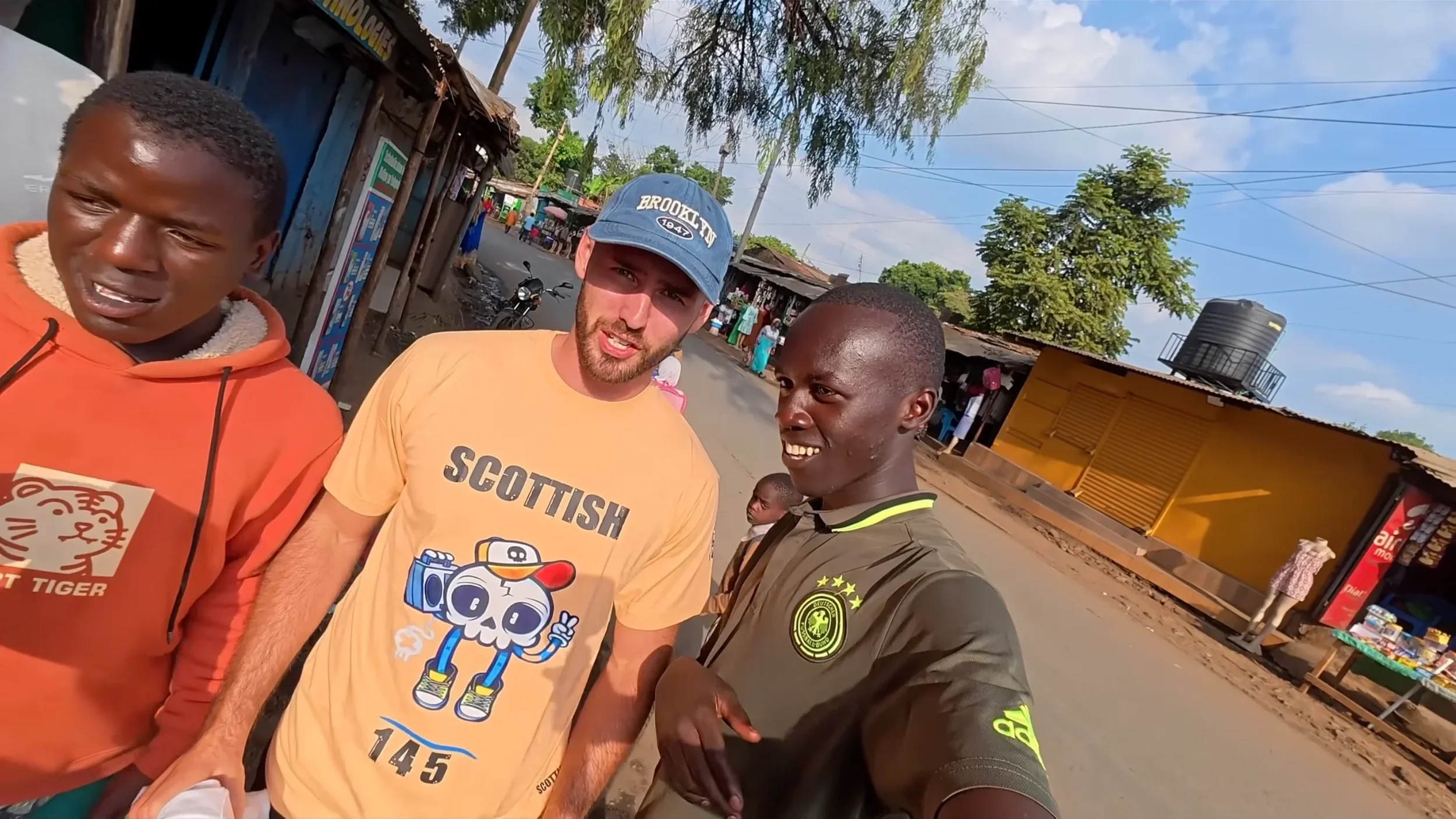
There I meet Jackson, the father of one of the boys. He has been living in Kibera his whole life, paying 4,000 shillings ($31) a month in rent for his kids and another 4,000 ($31) for himself and his wife. He is a carpenter, working daily, getting paid only what he earns that day with nothing guaranteed beyond it. He is 54 and looks about 42, acting about 35.
He wants to open a workshop. Give the boys skills. Show them a future. He says it simply, almost casually, like it is just a matter of time. I notice how genuinely happy he seems while saying all of this and I ask him why, given everything around him. He says:
“If you are not happy, you die tomorrow. You just do not know. But if you are happy, you go long.”
I do not have an argument for that so I offer to buy drinks for everyone. I get a bottle of Coke, some bread, water and biscuits. There is another maths situation at the counter, different shopkeeper, same energy, but we sort it out eventually.
They invite me to see where they live. It is a small room made of mud, everything stacked up on top of everything else, more items than you would think possible in that amount of space. I am surprised to find they have electricity. We sit down on the couch and after some conversations that I will keep private, I decide to give whatever cash I have left to the group. $100 split between everyone who had walked with me that day, Jackson included. I wish it had been more, but that was all I had left.
Then Jackson and the boys walk me out of Kibera. We stop to pick up the t-shirt on the way out. It comes out great. Orange. Scottish 145 on the front.
But now it is time to say goodbye.
Final thoughts
Kibera is complicated. It is poor in a way that is genuinely difficult to sit with, especially when you can look up from where you are standing and see a highway overpass and government buildings right there on the horizon. The contrast is not subtle, and the people who live there are not unaware of it. They talk about it directly, clearly, and without the kind of bitterness you might expect. They are not waiting around for someone to feel sorry for them.
What I found in Kibera was exactly what I went looking for. Kindness. In abundance. From people with a lot less reason to be generous than most of the people I meet anywhere else in the world.
A music producer teaching himself on one speaker. A comedian who can make you laugh and then quietly break your heart in the same conversation. A 20-year-old who paid his own school fees doing hard labour and still has not been given a fair shot. A crew of guys who named a patch of ground after themselves and built something out of it anyway.
Kibera does not need your pity. It just deserves more than it gets. There is a difference, and the people there will be the first to tell you so.
-
Need an eSIM when you travel? Check out Globie eSim →
Want daily emails from me? Sign up here →