Hitchhiking to Palmyra Inside an Active War Zone
In December last year, two American soldiers and their interpreter were killed by an ISIS-affiliated gunman in Palmyra. Their names were Sergeant Edgar Torres-Tovar and Sergeant William Howard, both of the Iowa National Guard. The gunman had been a member of the Syrian security forces. His dismissal for extremist views had been scheduled for the following day but he didn’t know.
Trump ordered a military response. Over 70 ISIS locations got bombed. And at the time I filmed this, those bombings were still happening.
So naturally, I decided to hitchhike there.
I was in Homs. Palmyra is about as deep into Syria as you can go, right in the middle of the desert, which is exactly why ISIS liked it so much. At its peak the city was pulling in over 150,000 tourists a month. Ancient ruins, UNESCO heritage sites, one of the most historically significant places on earth. Now it is essentially a ghost town with active airstrikes happening nearby and unexploded ordnance sitting in the streets.
The only reason we were not bombed on the way there, as I found out later, is because someone texted a soldier who texted the Americans to let them know we were coming. I did not know this at the time. I found out while standing in the desert at night. More on that later.
The Journey Starts Here
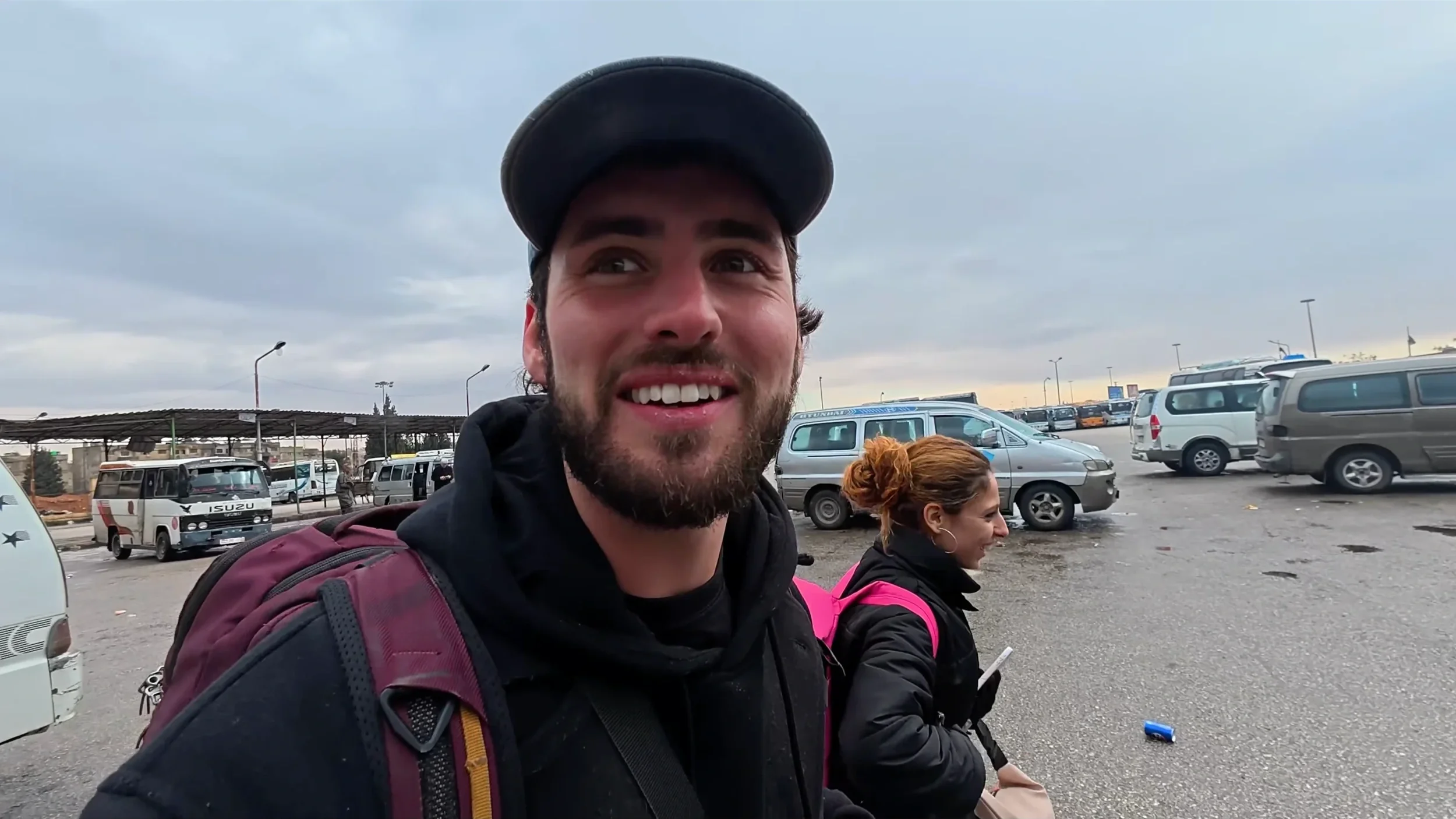
Step one of hitchhiking anywhere is finding a lift. In Syria, apparently, step one also involves walking past a market stall selling brass knuckles, pistols, and hunting knives inside the actual bus station. Right there between the snacks and the phone chargers. I am not making that up. They were fake, though, which I found out after staring at them for slightly too long.
Rita joined me on this particular exercise in poor decision-making, and we immediately clocked the fake gun lighter on one of the stalls. It looked genuinely indistinguishable from a real pistol. Rita wanted to buy it. I said absolutely not. We bought it.
It cost around $12, which in retrospect was both too much and exactly the right price for the chaos it would go on to cause for the rest of the day.
We also changed money. $100 gets you 1.1 million Syrian pounds at the current rate. I handed over a bill and received what felt like a small brick of cash in return.
Then we ate some traditional sweets from a nearby stall, including one called bird's nest, which was extremely sugary, extremely good, and absolutely no preparation whatsoever for what the rest of the day had in store. Then we tried to find a ride.
Getting Out of Homs (Harder Than It Sounds)
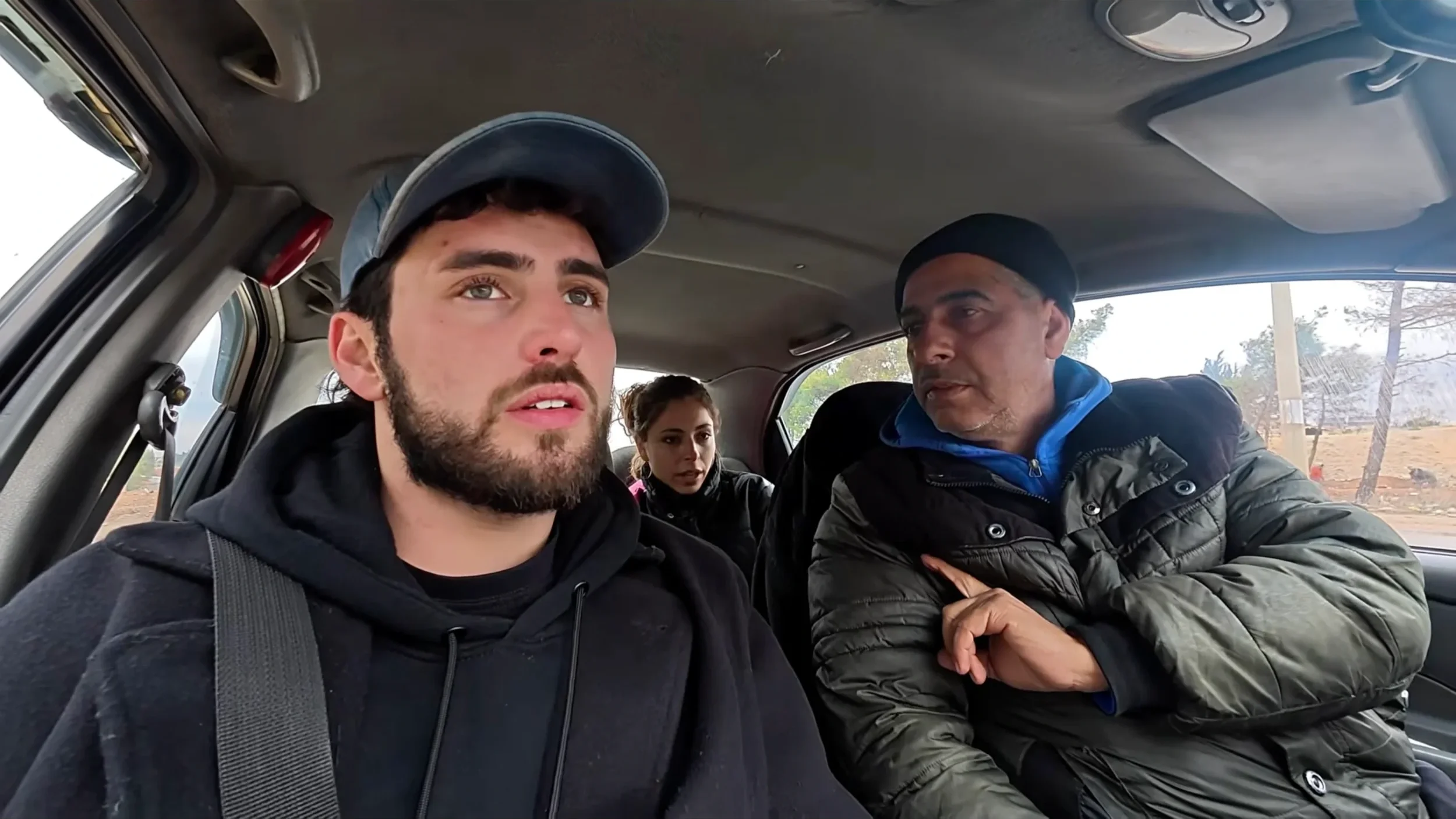
Hitchhiking out of Homs toward Palmyra turned out to be significantly harder than I expected, which probably should have been my first sign that this was not going to be straightforward.
We waited at a checkpoint for about 30 minutes. Not one person was heading to Palmyra. The military were around. Rita still had the fake gun in her pocket and I was deeply uncomfortable about this specific combination of circumstances.
Eventually we paid for a short ride about 6km back to the main turnoff, where anyone heading toward Palmyra would have to pass through. As we got close to where we had originally told the driver to stop, we realised we needed to go a bit further along, so we asked him to keep going. He agreed, for more money of course. Once we got there, he named a price that was significantly more than any reasonable person would call fair for what was essentially an extra 10 minutes of driving. We should have agreed the figure in advance, that is on us, but he had also done a very small amount of extra distance and was asking for nearly double the original fare, which did not add up in any language.
Rita negotiated in Arabic. I stood nearby looking as useful as a person who does not speak Arabic can look in that situation, which is not very useful at all. It sounded heated. It was probably heated. Eventually we let him win, because we did not have many options out there, and moved on.
Finding a ride in the middle of nowhere
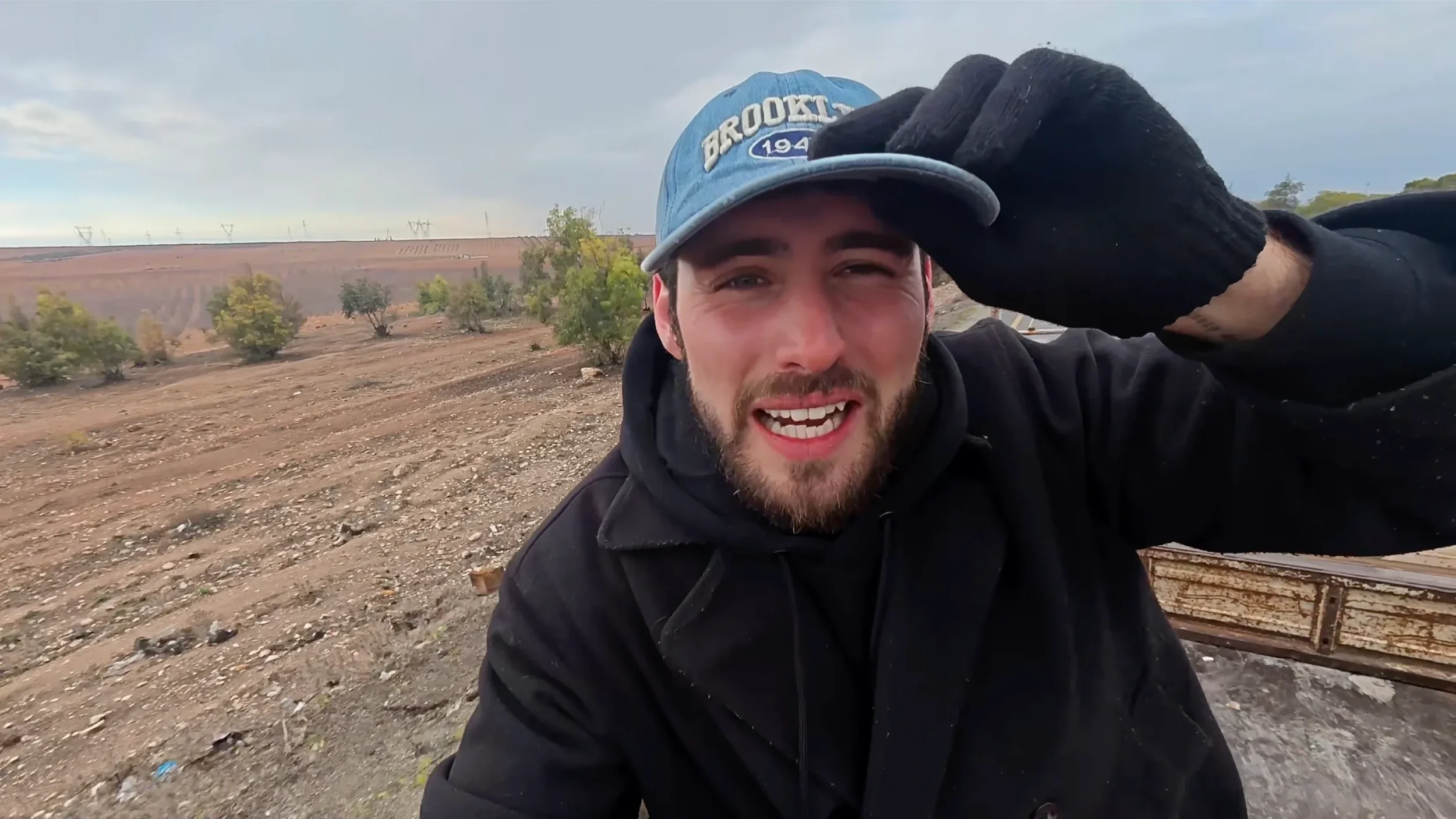
Once we reached the turnoff there was not much around except a small roadside shack where a guy was selling crisps and the usual basics. He offered us coffee, instant stuff, and I tried it out of politeness. It was not good. We drank it anyway because we were standing in the Syrian desert with nothing else to do while waiting for a truck heading east.
A few passed. The first was going somewhere else entirely. A couple more did not stop. Then one came from the opposite direction, slowed down, and did a full U-turn on the highway to come back and talk to us. They were heading home and after a brief conversation decided to take us to Palmyra, which was unexpected given that they were driving the other way entirely
That is Syrian hospitality. They turned around on a desert highway to give two strangers a lift in the direction they had just come from, handed us blankets because it was genuinely freezing, and did not make anything of it. There were a few military checkpoints along the way, and at one of them the soldiers assumed I was Syrian because of my beard, which I decided to take as a compliment. The ride was about 2 hours across open desert and it was one of those journeys where you look out of the window and realise you are somewhere that very few people will ever sit and watch go past.
The Ex-Russian Base on Top of a Castle
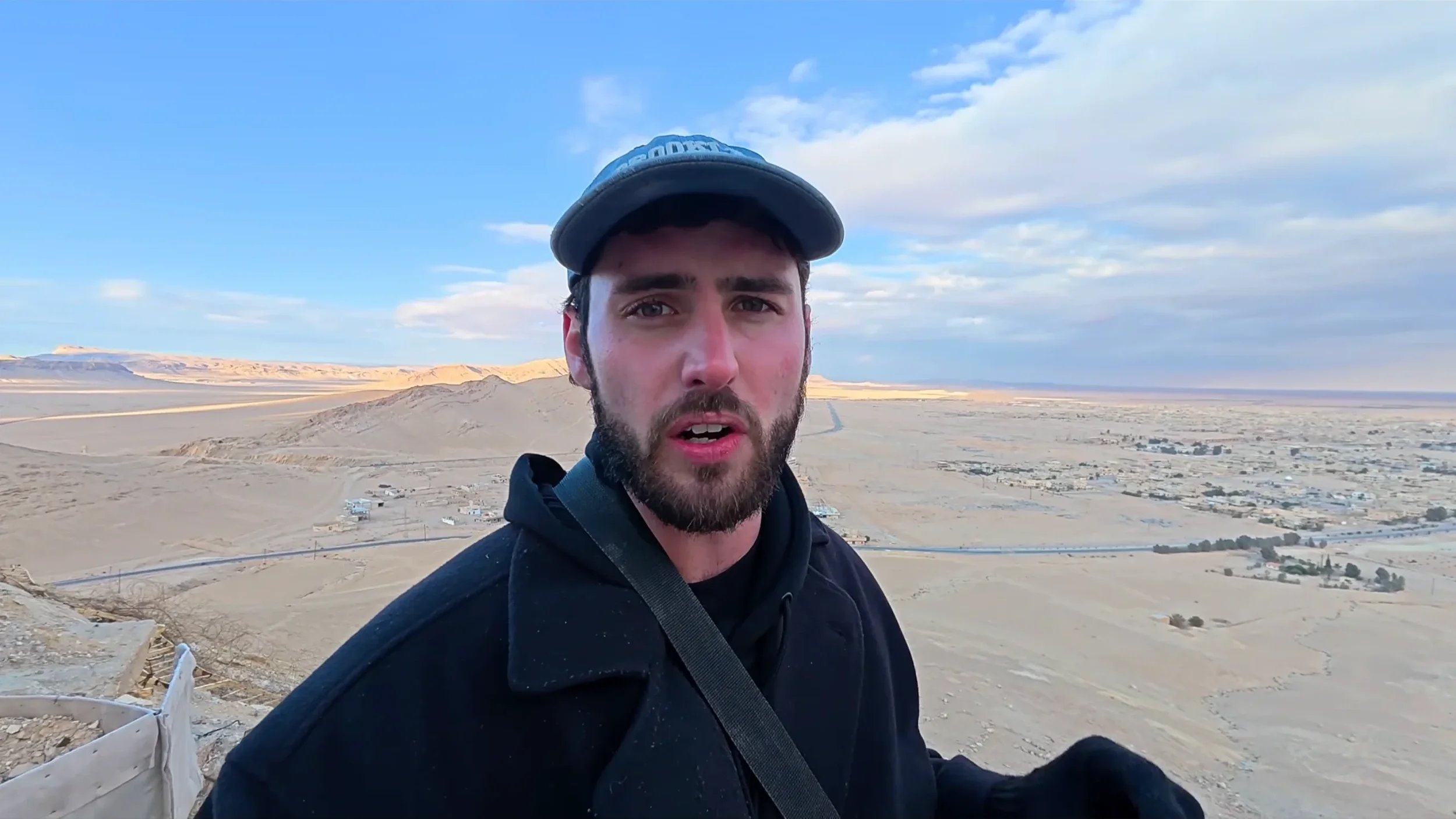
We made it to Palmyra after far longer than expected. The city comes up on you suddenly, the desert giving way to destroyed streets and then, up on the hill above everything, the castle.
This is where the Russians had a base during the conflict. Getting up there involved crossing a bridge that I would generously describe as structurally optimistic. The entry point was a metal ladder bridging a gap between two sections of the structure, suspended over a drop that I did not look down into for long enough to measure. It reminded me of that scene in Lord of the Rings where Gandalf is on the bridge in Moria, except nobody was going to dramatically sacrifice themselves and I was carrying a camera. We spread our weight across the metal frame carefully, moved slowly, and made it across in a way that felt more like negotiating with the bridge than actually crossing it.
The view from the top is one of the most genuinely stunning things I have ever seen. Ancient ruins thousands of years old spread out across the desert below, the columns of Palmyra still partially standing, the landscape unchanged in a way the buildings are not. Palmyra was a major city on the Silk Road, a trading hub between East and West for centuries, and standing above it you get a sense of what it meant before the 20th century decided to fight several wars on top of it.
That is when Rita told me about Queen Zenobia. She ruled Palmyra, put her face on the coinage, and went to war with the Roman Empire. When the Romans finally came to take her there are 3 versions of what happened. Rita believes she poisoned herself rather than be taken as a slave. "She was a very, very strong queen," she said. "She was not going to accept for less."
I stood on a castle in the middle of an active conflict zone and thought about a queen who died rather than kneel. It sat with me for a while.
The castle itself had been occupied by multiple different forces across the course of the war. The Russians were here. Assad was here. ISIS was here. They all used it at various points. What is left is still extraordinary, which tells you something about how extraordinary it must have been before any of them arrived.
Inside Palmyra Prison
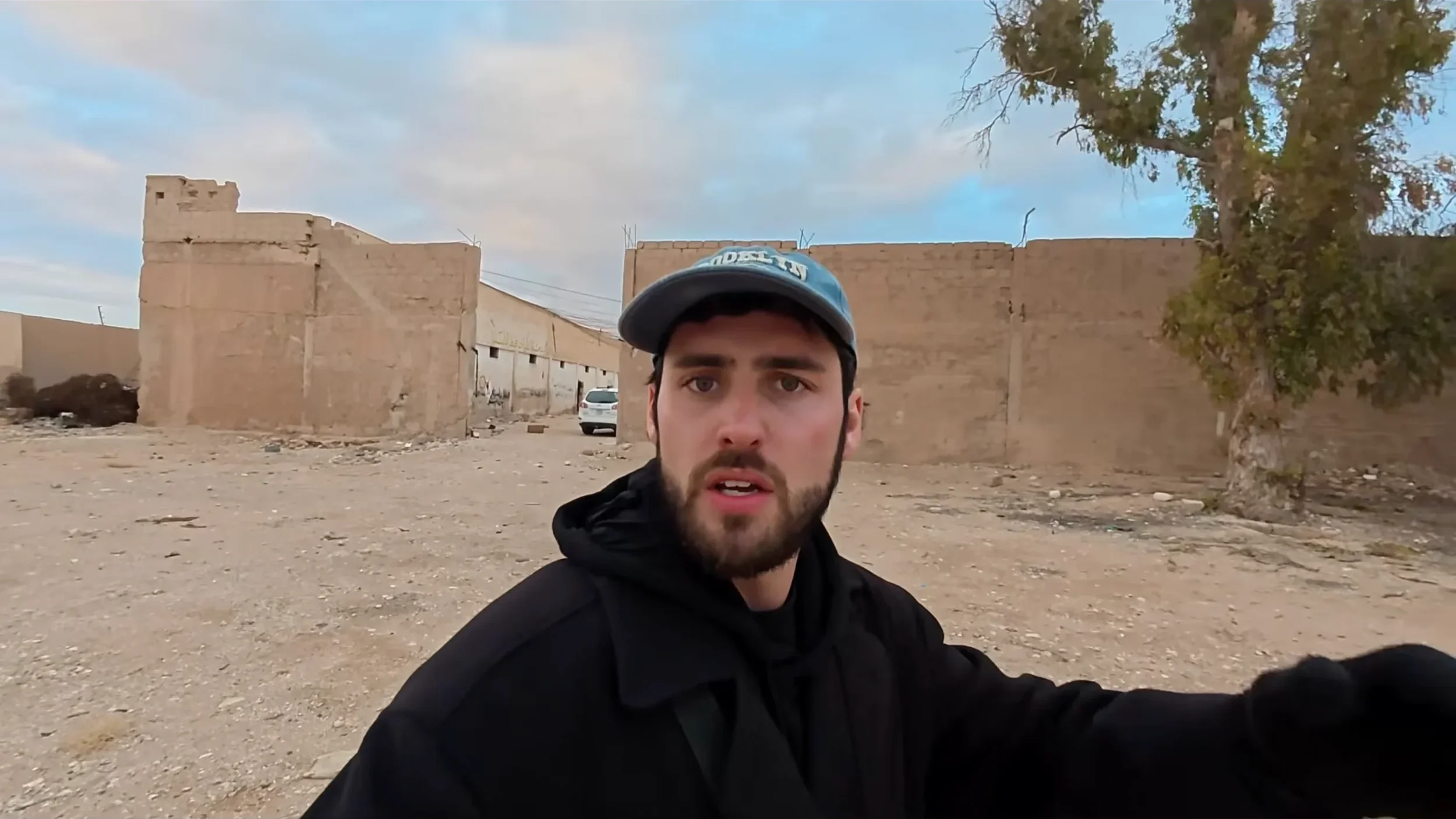
After the castle, a Bedouin guide who was a friend of Rita came to pick us up and drove us to the prison.
It started as Assad's political prison and covers over 20 kilometres in area. That number did not fully land until I was standing inside it. If you ended up here, you were looking at 30 to 40 years minimum, or execution. The guide told me about a Lebanese Christian man who was put here after someone in his neighbourhood reported him to the authorities. He spent 30 years inside before anyone worked out he was not Syrian. He survived. He wrote a book.
Then ISIS took the prison in 2015. Then Iran and Russia helped Assad retake it in 2016. Then ISIS bombed it on their way out, reportedly to destroy evidence of what had happened there under Assad's rule.
The underground section is where the most serious prisoners were kept. Narrow corridors. Low ceilings. The kind of dark that does not lift when your eyes adjust. Solitary cells with no light, food dropped through holes in the ceiling so guards never had to interact with the people inside. One meal a day. Bathroom access once a day. I am about 6'2 and when I lay down in one of the cells, my feet touched one wall and my head was less than an inch from the other. Hard concrete floor. No sheets. No light. No sound except whatever your own mind produces when there is nothing else coming in.
People spent years in those cells. Multiple years. Years. I had been complaining about the cold all day and I was walking in and out of these rooms with a camera and a jacket on.
In the execution room the walls still had old photos of Assad that had since been covered in graffiti by people who came after his fall. Names of the disappeared. Dates. A drawing of a broken chain. And written in translation across one wall, in large letters:
"You don't think this land is for you. This land is for God."
Someone had written it in a place where people were brought to die for disagreeing with the man in the photographs. It was not subtle and it was not meant to be.
Sleeping in the Desert at a Bedouin Camp
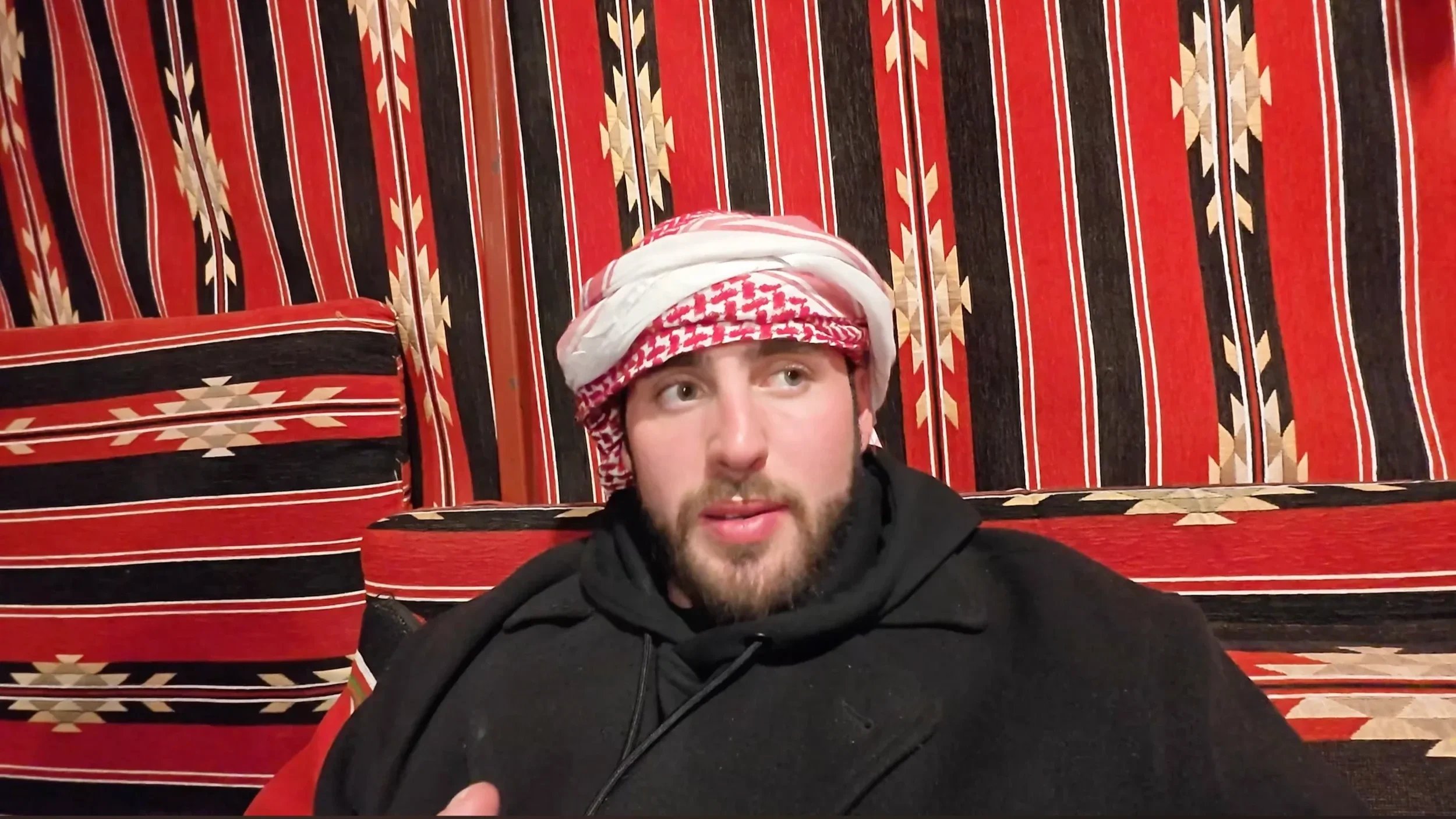
After the prison we ended up at a Bedouin camp just outside the city. Shoes off at the entrance. Live music by the fire. A host who had the calm, easy hospitality of someone who has been welcoming strangers into his home his whole life and sees no reason to stop.
The Bedouin people, as the guide explained it, are built differently from generations of living in extreme conditions: severe cold, severe heat, long stretches without food or water. The comparison that made the most sense to me was the nomadic people of Mongolia or Kyrgyzstan, the Middle Eastern version of that kind of endurance.
Then came the sulfur shower.
It was around 9pm, pitch dark, somewhere in the Palmyra desert. Before we left the camp, the host loaded an AK-47 into the vehicle because we were heading into an area where ISIS camps are genuinely located. I assumed he was being cautious. He was being accurate. It was during this drive that he explained, completely casually, that the only reason we had not been struck from the air on the way to Palmyra was because someone had messaged ahead to let the Americans know we were coming through.
"If you didn't, they would have struck within a second."
I sat with that for a moment.
The sulfur spring itself was extremely hot, extremely slippery, and smelled exactly like rotten eggs. It was also, genuinely, one of the more memorable experiences of the entire trip. I nearly fell twice getting in. The water has this quality where it burns just enough to make you feel like it might actually be doing something useful. We stood in the dark in the Syrian desert, surrounded by active ISIS territory, smelling like a broken sewer system, and I thought: yeah, this is travel.
After that we were taken further into the desert where someone appeared from the darkness and offered me the chance to fire their AK-47 at a ruined wall that already had a significant number of bullet holes in it. I thought about it for a split second and said yes. After the first shot I could not hear anything from my right ear, but I kept going. It is a strange feeling. It makes you feel something, power or adrenaline or both, but at the same time you are very aware that nothing good has ever come from what that object was built to do. A strange, complicated feeling that I am still not entirely sure how to describe.
On the drive back I asked if I could take the wheel for a stretch and they let me. I drove a car through the middle of a desert controlled by ISIS at night with no headlights on. That is, genuinely, great uncle lore.
The Temple of Bel
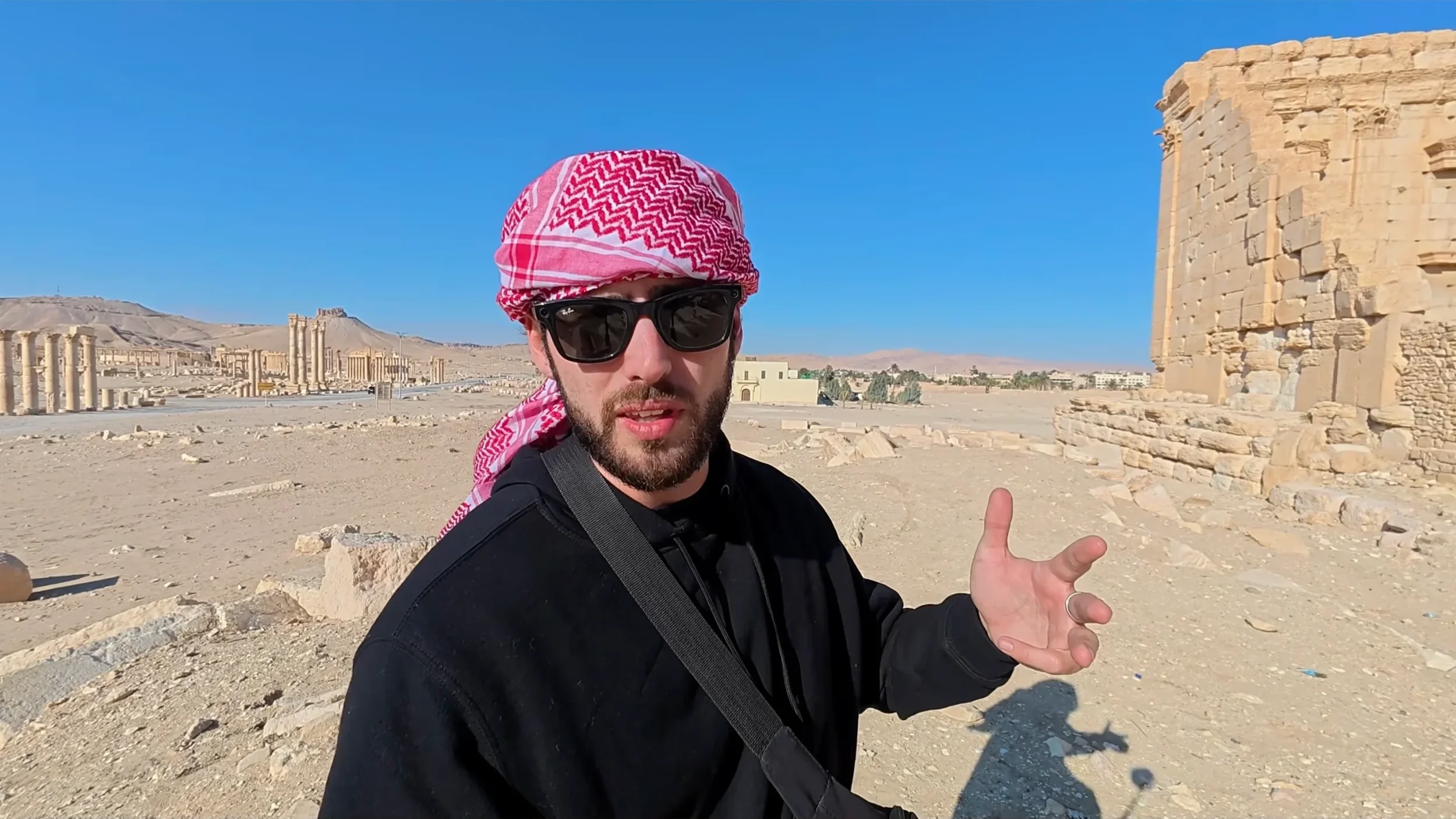
Morning came clear and blue. The castle was visible from the camp. We had a Bedouin breakfast: yogurt, tomatoes, bread, olives, and a technique demonstrated in great detail by the host involving bread dipped in onion, dipped in salt, dipped in yogurt. It sounds wrong. It tasted genuinely good.
Then I got on a camel and Rita got on a horse and we rode out to the ruins.
The Temple of Bel was built between roughly 50 BC and 40 AD. ISIS blew it up in August 2015. Some of it is still standing: the door frame, sections of the outer walls, parts of the columns. What survived gives you just enough to understand how extraordinary the whole thing must have been, which makes what happened to it feel even worse than if nothing had survived at all.
At the entrance I met Khaled. He was selling coins, handmade rings, and small souvenirs from a stall. He was born in Palmyra, left for 11 years during the worst of the conflict, and came back when the new government took over because, he said, it finally felt safe. In 2015 he was put in prison. Not because he had done anything. Just because someone reported him. He lost consciousness from the beatings 5 times. He said it very quietly and then moved on to showing me the Palestinian coins in his collection, like it was just a thing that had happened rather than a thing that should never have happened to anyone.
I bought 4 old Syrian coins for $20. He helped me sort out the change from a $100 bill without making it a thing. We shook hands and he went back to his stall.
The amphitheatre was right next to the temple. Two thousand years ago people watched performances here, possibly gladiators fighting to the death. I arrived on a camel. It felt about right.
Where the Americans were Killed
There is an active American base in Palmyra. I am not going to say much about it because we had to be careful filming anywhere near it. What I can tell you is that Sergeant Edgar Torres-Tovar and Sergeant William Howard, both 25 years old, both from the Iowa National Guard, were killed there by a lone gunman who had been part of the Syrian security forces. His dismissal for extremist views had been scheduled for the following day. He did not wait to find out.
About 200 metres from the base is a hospital that was bombed by Assad, Russia, and ISIS at various points during the conflict. Around the corner from that is a neighbourhood that Israel struck in 2024, targeting Iranian-backed fighters. The leader of those forces was killed in one of the houses there.
Every wall has bullet holes. Homes that look like they could come down at any moment. Kids playing in the streets between the rubble, completely unbothered by the architecture of destruction around them because they have never known anything else.
Syria has this way of making you feel the full weight of your own ordinary life without doing anything dramatic to achieve it. You just look at what is in front of you and it lands.
One more thing
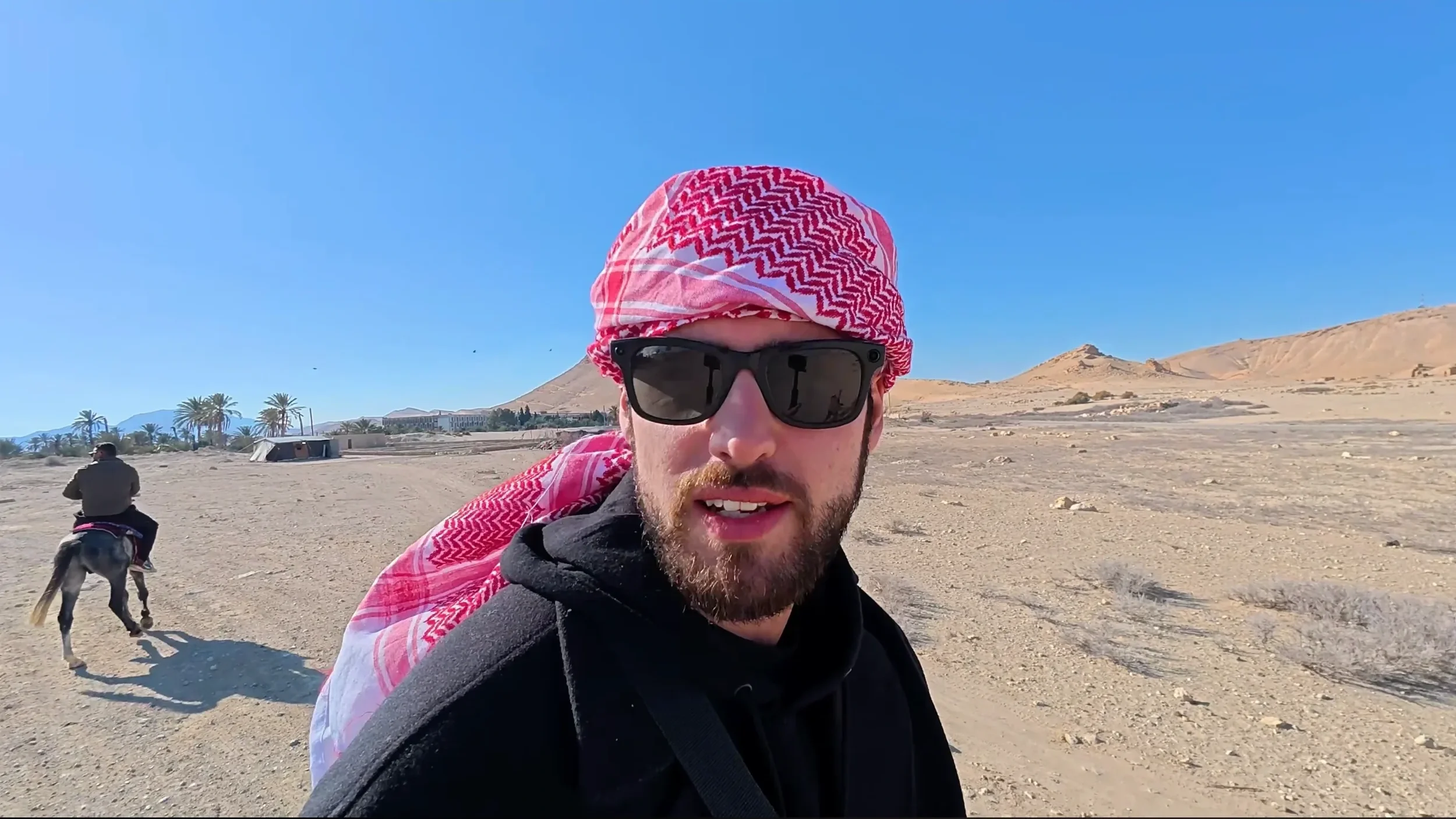
After leaving Palmyra I was headed toward Tartus.
That night, the UK and France began bombing ISIS locations in Palmyra. A few hours after I left. The footage they released showed a French or British fighter jet flying over the exact road we had driven on the way to the sulfur shower. I could see it clearly. The same road. The same desert.
The people we had met there, the host at the Bedouin camp, Khaled at his coin stall, the guys who had turned their truck around on a highway to give us a lift because that is just what you do, I have been trying to get details on how they are doing. Still waiting to hear back.
Palmyra is not somewhere you visit and then move on from cleanly. It stays with you in a way that is hard to explain unless you have been somewhere that carries that kind of accumulated weight: ancient history on top of living memory on top of destruction on top of people who are just trying to get through the day in the middle of all of it.
I hope everyone we met there is okay. I genuinely do not know if they are.
-
Need an eSIM when you travel? Check out Globie eSim →
Want daily emails from me? Sign up here →