48 Hours in Lesotho, the Country Inside South Africa
After Uganda and Burundi, I was genuinely close to giving up on Africa. Like actually done. But then someone pointed me toward Lesotho, a tiny landlocked country sitting entirely inside South Africa, and I figured I had nothing to lose. How bad could it be?
Turns out, not bad at all.
Welcome to Lesotho 🇱🇸
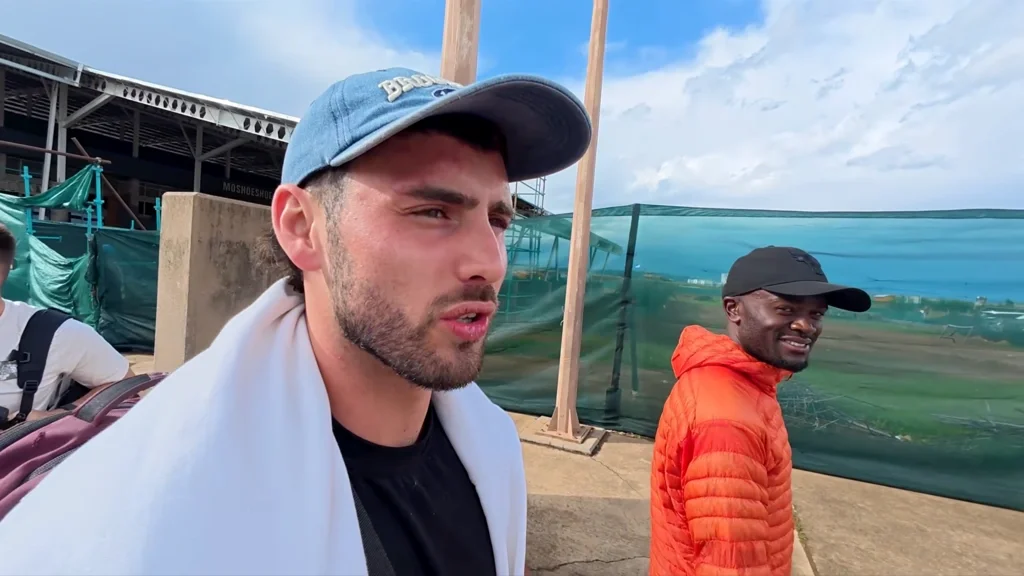
We land in Maseru, the capital, and immediately there is a debate about how to pronounce the country's name: Leh-SOO-too? Leh-SOH-toh? We debated this all the way through arrivals and even the locals couldn't settle it.
The first clue that this place plays by its own rules: the currency. It's called the Maloti, and it's pegged 1:1 to the South African rand. Practically speaking, you can use rand anywhere. No conversion, no confusion. The government pays to keep them equal. It's such a tidy little arrangement, and it perfectly sums up the spirit of Lesotho: pragmatic, quiet, and quietly brilliant.
Then we drove out of the airport. And Lesotho just showed off.
We'd landed at golden hour. The kind of light that makes everything look like it belongs in a painting. And then a rainbow appeared. A full, vivid arc stretching over the green hills. We barely had time to point at it before a second rainbow appeared right beside the first. Dramatic? Yes. Beautiful? Absolutely.
Our local contact Kay rode with us and spent the drive filling in the gaps. Winter here runs June through August, and the slopes are about three and a half hours from Maseru. People actually come to Lesotho to snowboard. In Africa. I've typed this sentence three times and it still doesn't feel real.
Kay also told us about the mountains' biggest export, and it's not what you'd expect. Not stone. Not scenery. Water. If you've ever taken a shower in Johannesburg, the water that hit you most likely flowed down from these peaks.
There are also diamond mines. And a locally bottled water brand whose owner is trying to ship it all the way to Kuwait. The bottle has an abseil printed on it, which as it turns out is exactly why we made this trip.
More on that soon.
Checking Into Simongkong Lodge
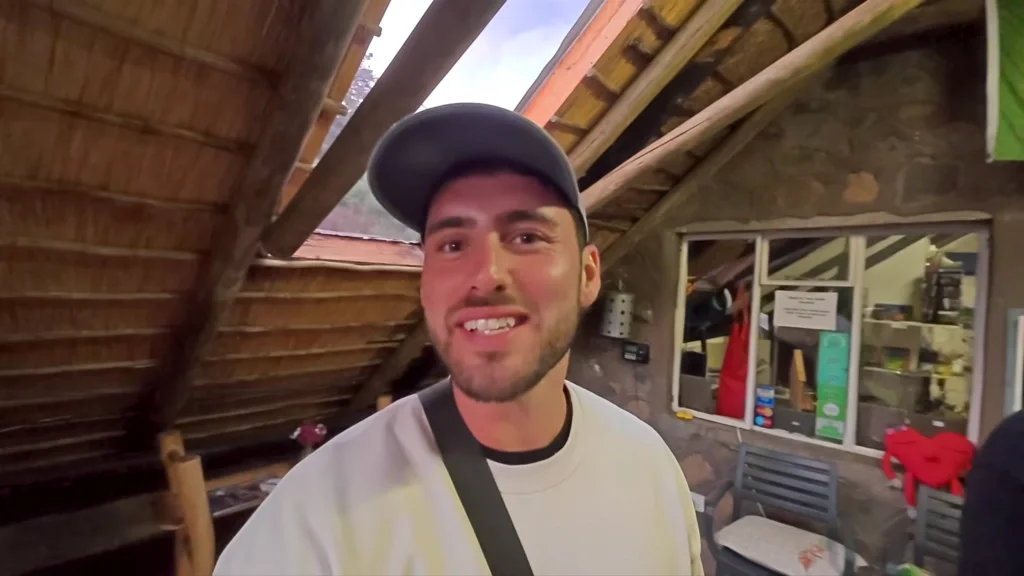
After the drive, we arrive at our base for the night. For the first night, we are staying at Semonkong Lodge and it is, in the best possible way, basic.
One bed and a bunk bed per chalet, which immediately creates a problem because there are three of us. To fix this we do a random name generator on the spot to decide who gets the double bed and who takes the bunks.
Believe it or not, I win the double bed. It's the first thing I have won in a long time and I am not going to pretend I was not delighted.
The second issue is that the lodge runs on a power schedule. On at 8am, off at 10pm. That is our window to get everything charged, and as you know we have a lot of stuff to charge every day: laptops, cameras, phones, batteries. We had a fire going all night using spruce wood blocks that each last about two hours, so you stack enough of them and you are sorted until morning. It genuinely felt like being on school camp, and I mean that as a compliment.
At around 8pm we headed over to the restaurant area. I had lamb chops with mash. The famous local dish apparently is pap and vleis, which is a kind of maize porridge with meat. We did not quite get there on night one, but the lamb was good. Cold. But good.
The altitude is worth mentioning here. We are sitting at 2,100 metres above sea level, and at that height you are getting twelve to fourteen percent less oxygen per breath compared to sea level. I am also extremely unfit, which does not help. But nobody died.
Day 1: Abseil Training and Why We Are Actually Here
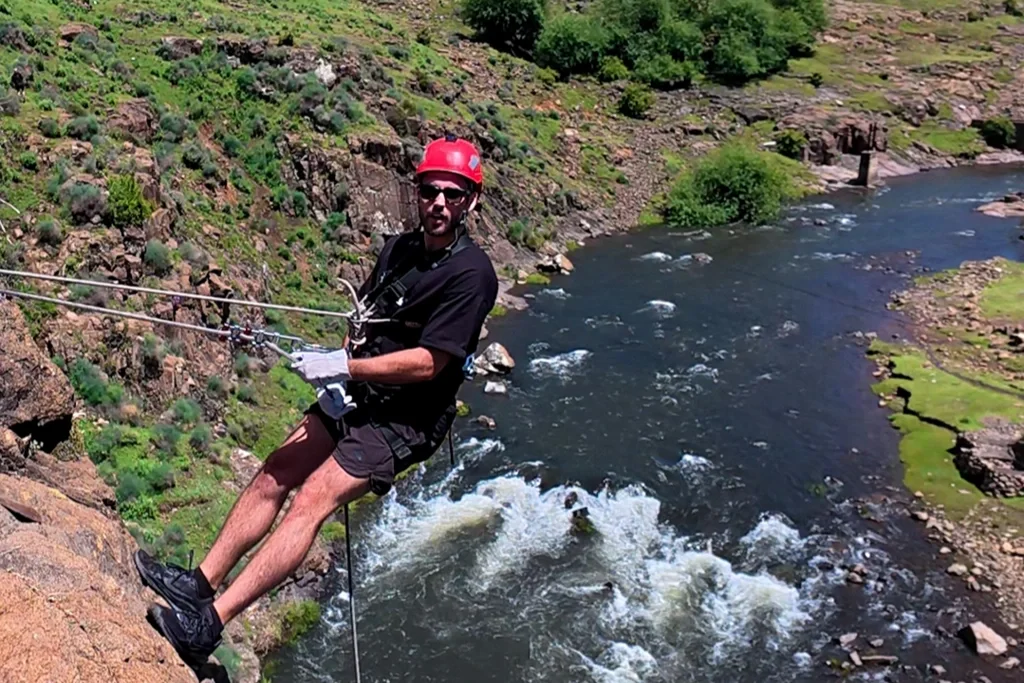
The next morning, after surviving the altitude and the cold lamb, it is time to find out what we actually came for.
The reason we are in Lesotho is to do the highest commercial abseil on the planet. It's long, 206m, making it a Guinness World Record, and before they let you anywhere near it, you have to pass a 25 metre training run.
Our instructor Le Role has been abseiling for one year. The senior guy on the team has been doing it for 21 years. I focus on the 21 year figure and try not to think about the other one.
The anchor setup is reassuring, at least. Four carabiners bolted into the ground, each rope rated to one tonne, with the full system holding two and a half tonnes. You feed the rope through a figure-eight device and that creates the friction that controls how fast you descend. Simple in theory. Still terrifying in practice.
Standing at the edge is a different thing entirely to hearing about it. I look down, say something unprintable, and decide that if I die here it was meant to happen. Though I did note that dying on the practice abseil in Lesotho, after surviving the Congo, Iraq, Syria, and everywhere else, would be genuinely embarrassing.
The first step off the edge is the worst part. Your brain sends a very clear message: this is not natural, please reconsider. Your legs disagree. The rope has a different opinion entirely. The rope wins.
And then something shifts. You are not falling, you are floating. Slowly, deliberately, with the valley opening up beneath you and the rock face inches from your nose. It is quieter than you expect. Just the rope, the wind, and whatever your brain is doing to keep itself from fully panicking.
Mine was mostly counting. Five metres. Still alive. Ten metres. Still alive. Good pace. Great pace actually.
You reach the bottom and your legs immediately pretend they were never scared. You unhook, look back up at the cliff face, and feel a specific kind of proud that is slightly embarrassing to admit out loud. Once back up I ask if I did the biggest jump out of everyone. They confirmed. Full Spider-Man energy.
Twenty-five metres, done. Two hundred and six to go.
Donkey Racing in the Mountains
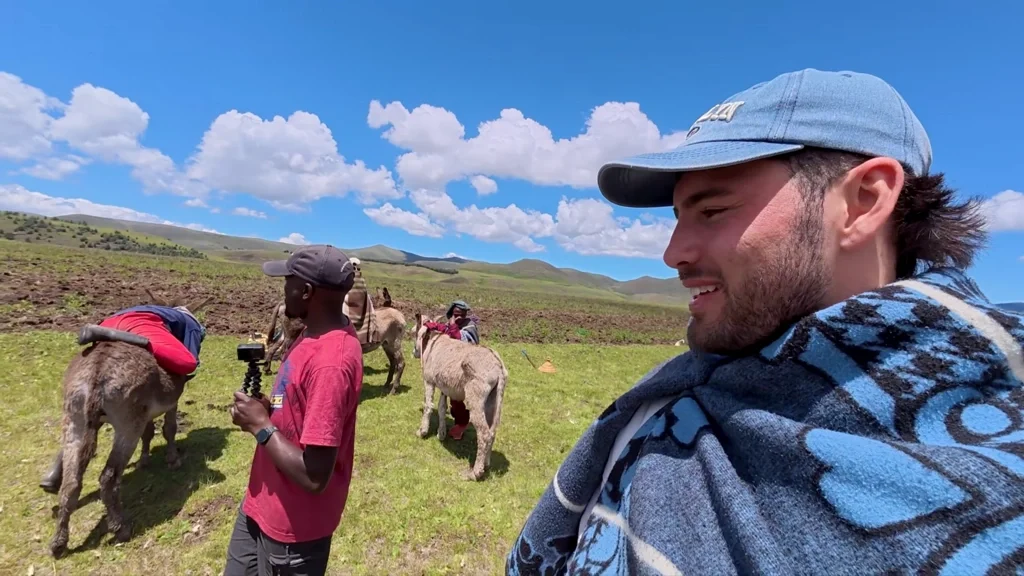
After training, we walk 2 kilometres through the mountains to watch, and eventually participate in, a donkey racing competition. And I want you to understand that this was not a tourist attraction, we just happened to show up and they let us join in.
The old men in this area actually bet on these races and the format is very simple. Ten donkeys. First round is head-to-head heats. The winners go through to a quarterfinal, then a semifinal, then a final. The losers get a redemption bracket.
There are prize payouts. First place takes 300 Maloti ($18), second gets 250 Maloti ($15), third 200 Maloti ($12), fourth 150 Maloti ($9), and the remaining 6 get 120 Maloti ($7) each.
Donkeys in Lesotho cost between 15,000 ($900) and 20,000 Maloti ($1,200), or sometimes nothing if you know the right person. They are the primary form of transport up here, used for getting goods across the mountain terrain and for getting people to clinics from remote areas. Kay tells us kids start learning to ride from around 5 years old. One of the locals jumps into the conversation and jokingly says that they learn from pregnancy.
We each picked a donkey for the final and made a side bet among ourselves. £10 ($13) to the winner, and of course my donkey came third. Kieran's won, and he didn't even wanna play. Classic.
After the race we actually got to ride them too, which is its own experience. As soon as you sit on one you feel their spine hitting directly into your backside, and it goes on for the entire ride. Honestly though, I have ridden worse things, but not recently (wink, wink).
We took the chance and ran another bet among us: first to reach the finish line wins another £10 ($13). The ride starts with me leading, but then I see Harry sneaking up on me from the left, followed by Kieran. As soon as Harry takes over he actually falls off the donkey, which keeps running on its own with Harry chasing after it. It was hilarious. Kieran, meanwhile, managed to overtake everyone and won. Again. Unbelievable.
After that we packed up and headed back to the main part of the village.
The Donkey Bar Crawl
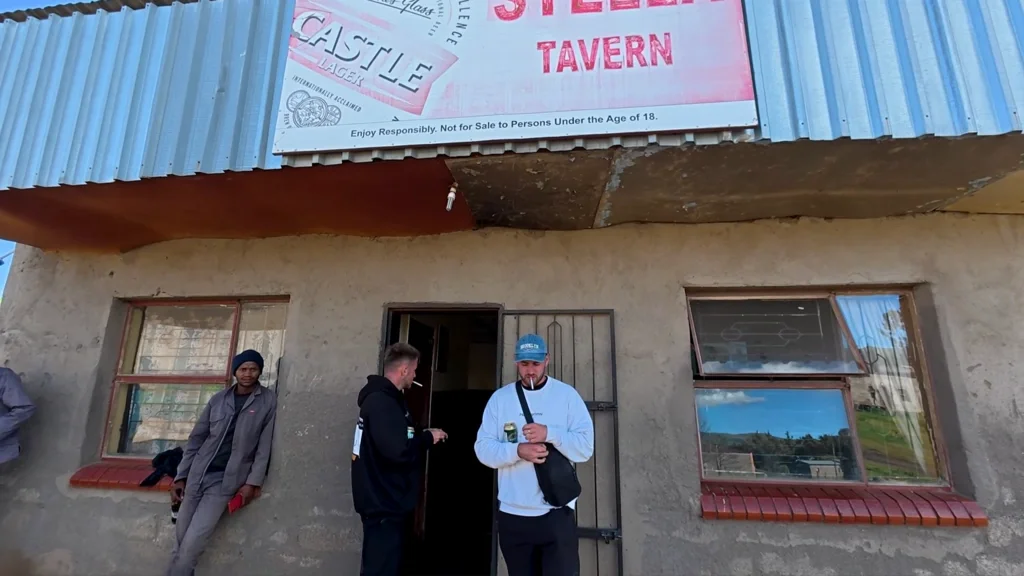
Nobody planned this specifically, but once you have spent an afternoon racing donkeys it seems only logical to then ride them to 3 local bars, so that is what we did.
The bars here are called taverns, not pubs, and the first drink was something called Donkey Blood, which turned out to be Sambuca. It was terrible in the way that Sambuca always is, we cheered and started our journey through the village.
The local beer is called Maluti, it is 4.8% alcohol, legitimately good, and the bottle literally says "Don't drink and drive" on it. We discussed at length whether that applies to donkeys, but the consensus was probably not, and the police presence here is minimal anyway, so even where it exists Kay gave us some insight into how flexible the enforcement tends to be.
We also tried the local cigarettes, which is a tradition at this point because the rule is you try the cigarettes in every new country. These ones were not made in Lesotho since the country is too small to manufacture its own, but they are the most popular brand here and not as harsh as some I have had in other parts of Africa, quite a smooth pull actually.
The 2nd bar had a pool table, which sounds like a good time until I tell you that I lost embarrassingly to someone I genuinely thought I could beat, and the defeat was thorough enough that I would rather not go into detail. We stayed longer than planned, partly because the vibe was good and partly because losing makes you want to order another round and try to forget about it.
The 3rd bar had a slot machine that took my money in about 45 seconds flat, which is impressive in its own awful way, though in fairness the same bar served 2 Coronas for A$5 ($4) so the evening financially balanced out even if my pride did not fully recover.
Day two: The Morning and the World Record Abseil
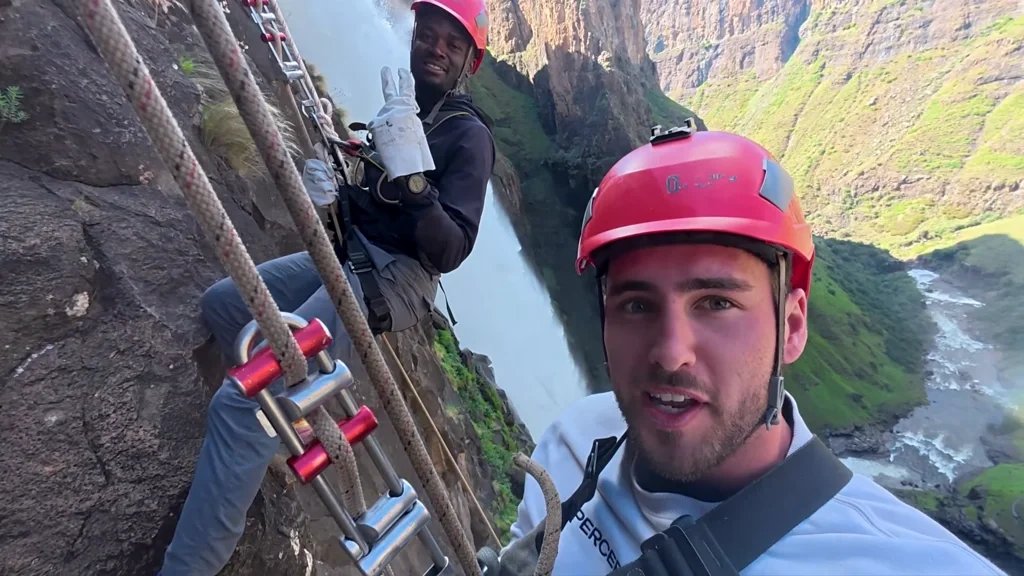
Alarm at 6am. The abseil itself is at the end of a walk, with the horses carrying all the ropes and equipment to the start point because the gear alone is basically a quarter of a kilometre of very heavy rope, so let that land for a moment.
206 metres. The first 20 metres are a free fall, meaning there is no rock face to push off and you are simply hanging in the air, feeding yourself down a rope and spinning slightly if the wind catches you, and after that you reach the rock platform and do the remaining 180 metres down the cliff itself.
There is also a waterfall. At the bottom, you go directly through it and it is not optional, but we will get there.
I am not going to pretend I was calm at the top, in fact my heart was beating in a way that is not medically ideal. I look down and genuinely cannot see the bottom. The spotters at the edge control your safety line and can manage your pace if needed, which when you are trying to hold a camera with one hand is more useful than I can explain.
Kay is on the rope beside me and even he looks like he is having a quiet word with himself. We start going down together and the first thing you notice is how much emptiness is below you, not rock, not water, just open valley dropping away into nothing. At some point around the 50 metre mark, I look across at Kay and he gives me one of those nods that means he is fine but is absolutely not fine, and honestly it made me feel better knowing I was not the only one quietly negotiating with the situation. You reach for the rock face when you can just to feel something solid, a quick push off the cliff to reset your spin, a moment to breathe, and then you let go again and keep going.
The waterfall at the bottom is insane in the most specific way and the worst thing is nobody told me about it in advance, I would have suited up appropriately for that mission. When the wind moves, the water whips you from every direction and there is absolutely nothing you can do about it, and by the time I reached the bottom I had never been that wet in my entire life. The ground was a mix of mud and rock, I was soaked through entirely, and somehow I was also extremely happy about what I had just done. Until I heard the most awful news.
We had to hike back up.
A 45 minute hike, 1 hour if you are struggling, and nobody had mentioned this part before we committed, which I think was deliberate and entirely correct. I would have personally preferred to abseil back up instead. On the way up, Harry and I took the chance to let go of some stress by shouting into the open air with whatever was left in our lungs, which was not helpful for the rest of the hike but was absolutely therapeutic.
Once back up top, we reached the small shack nearby to eat some food and sign the record book. The entries go back to 2012 and each person gets their own entry number, and my name is now sitting at number 7,383. Under the comments column, right next to my name, I wrote: no comment. It was funnier in the moment, no judging please.
One Night in the Presidential Suite
After food we went back to the lodge, chilled for a bit, packed our stuff and in the afternoon headed back to the city centre where the boys and I said our goodbyes and continued on our own separate adventures. Mine, definitely relaxing. Theirs, well, I will leave it up to you to decide what travelling to Syria looks like.
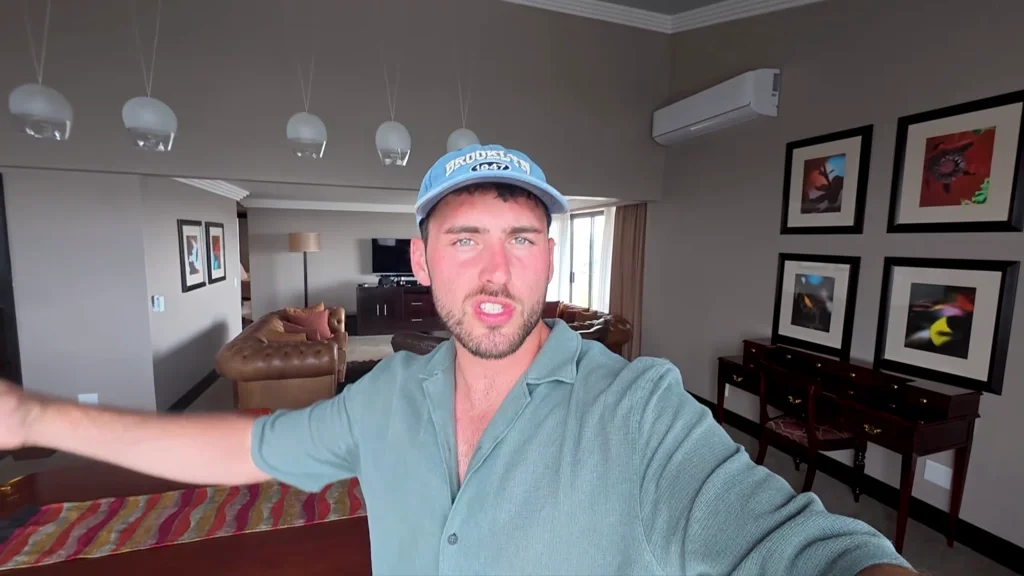
After the boys departed for the airport, I checked myself into the Avani, the best hotel in Maseru, and somehow ended up in the presidential suite for A$69 ($50) a night. Although it was not really the plan, or actually it was but… ah, just let me explain.
There was a booking mix-up and the mistake was mine, which I am not surprised about. I realised there was an issue while paying because the total was a third of what I expected, so I thought briefly that I was getting a discount, then thought more carefully about it and no, I was not getting a discount, I had simply booked the wrong room. The hotel sorted it out and upgraded me anyway, which is the best possible outcome of being an idiot.
Finding the room was its own mission though. The room number I was looking for was literally nowhere to be seen, and I mean genuinely nowhere, it was worse than trying to find the right staircase at Hogwarts. Eventually I decided to try my luck with one random door and that was the one. My room was 501 and apparently it was sitting between 506 and 507. Make it make sense. Anyways…
The suite has 2 bathrooms, a full kitchen, a dining table that seats several people, leather couches that look expensive and feel terrible to sit on, and a balcony with an uninterrupted view across the mountains. There are 2 presidential suites in this hotel, and this is where the king of Lesotho stays, the prime minister, all sorts of important people, and me, in wet shoes I bought a few days ago at a street market, with an unclean beard, dragging a homeless-looking bag through the lobby.
The bed passed the test, which if you have followed any amount of my content you know means something. Beyond the bed though, the room was okay, nothing exceptional.
At some point during check-in I jokingly suggested to the front desk that they should send up a welcome gift to make up for the booking confusion, which again was entirely my fault. A few hours later, a chest of local Lesotho snacks was delivered to my room, courtesy of the check-in lady. I did not expect that at all and it was a genuinely lovely touch, this country really does not miss.
And just like that, the trip was done. 48 hours in a country I had never heard much about, a Guinness World Record abseil, donkey racing with old men who bet real money, a bar crawl on actual donkeys, and a night in a suite fit for a king, which technically it is. Lesotho came out of nowhere and delivered more than most places I have planned for months. Sometimes the ones you least expect are the ones that stick.
Final Thoughts
Lesotho is not on most people's radar and I genuinely do not understand why. The nature alone is worth the trip. Mountains everywhere, more shades of green than you knew existed, waterfalls, horses just walking along the roads with guys in blankets and balaclavas on top of them like it is Red Dead Redemption.
Everybody we met was friendly, nobody was scared of the camera, nobody asked for anything. Just waves and hellos.
After Uganda and Burundi knocked the wind out of me, Lesotho quietly put it back in. The best travel experiences I have had are almost never the ones I planned the hardest for, they are the ones where I showed up not knowing what to expect and left not knowing how to explain it.
If you are planning an Africa trip and you want something different, this is it. Go before everyone else figures it out.
Africa, after everything, you redeemed yourself.
-
Need an eSIM when you travel? Check out Globie eSim →
Want daily emails from me? Sign up here →