I Explore Syria’s City of Ghosts: Jobar
There are some places in the world that stop you in your tracks. Not because they are beautiful, but because the weight of what happened there hits you before you have even finished looking around.
Jobar is one of those places.
Ten minutes outside of Damascus. A short drive from functioning restaurants, from people going about their day, from a city that is slowly piecing itself back together after years of war. And then you turn a corner and you are looking at what can only be described as the end of the world. Buildings collapsed in on themselves. Streets that lead nowhere. The kind of silence that is not peaceful, it is just empty, because everything that used to fill it is gone.
I had seen destruction before in my travels, conflict zones, flood damage. But Jobar is different. It is not a place that was caught in crossfire or suffered collateral damage. This was deliberate. Sustained. Methodical. The goal was not to defeat the people here. The goal was to erase the place they lived in entirely.
And for a long time, it almost worked.
The City That Held Out
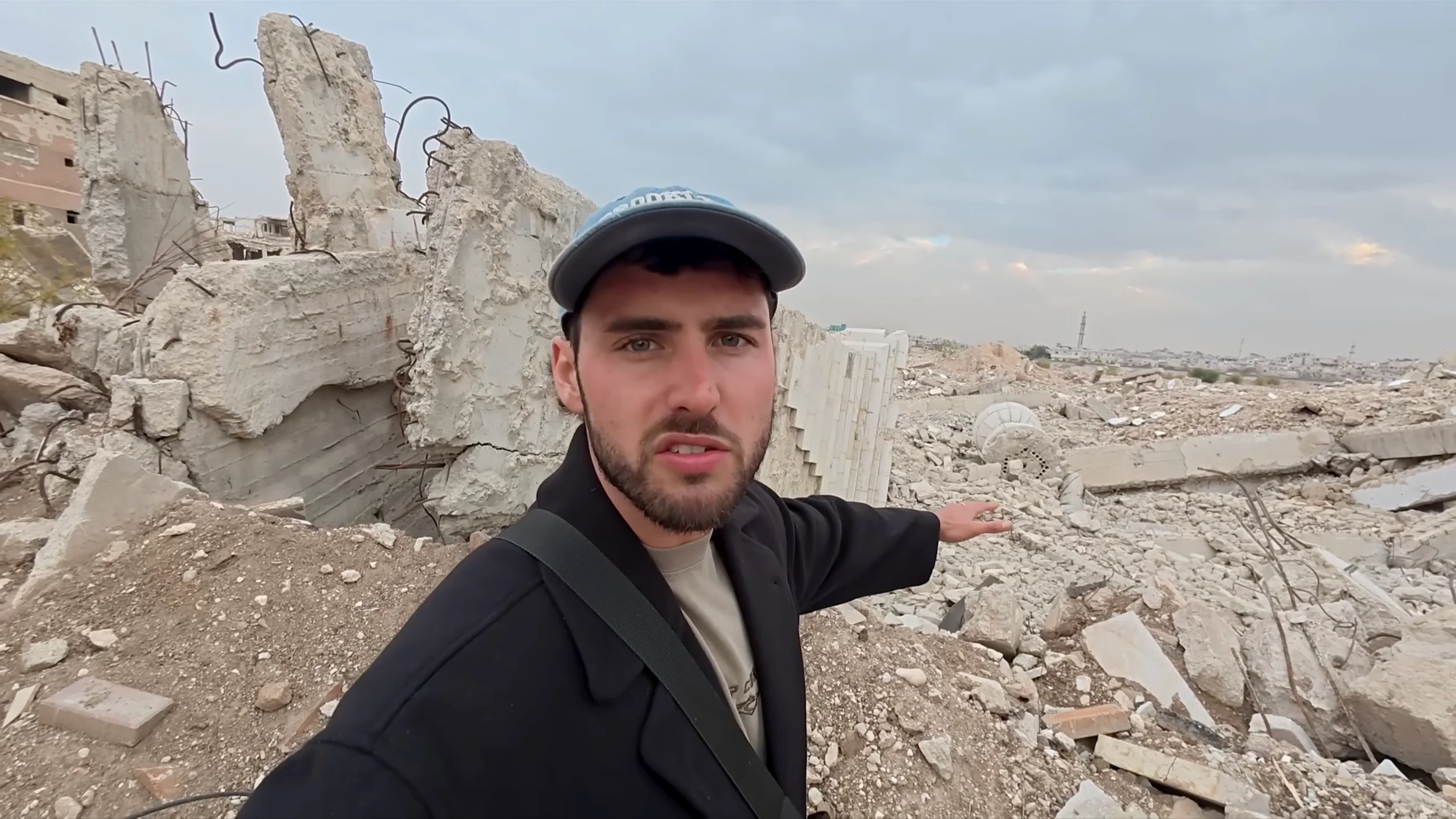
Jobar was not just another neighbourhood that got caught in the crossfire. When the Syrian revolution started in 2011, Jobar was one of the first areas where people rose up against Assad, and crucially, it became one of the only places in the Damascus area he was never able to fully control for almost a decade.
The reason was an underground tunnel network stretching across the entire Damascus countryside, dug by the resistance themselves, with their own hands and basic tools. While Assad's forces were above ground trying to bomb them into submission, they were below it, connecting neighbourhoods, moving supplies, running field hospitals and ambulances through the dark. Some of the main tunnels were built wide enough to fit cars. There were rooms carved out for weapons storage, side passages branching off in every direction, kilometres of them running under the streets.
The price for that resistance was everything you can see above ground today. Because if Assad could not get in, he was going to make sure there was nothing worth getting into.
What used to be one of the wealthier areas of Damascus is now a ghost city. At its peak, over 100,000 families lived here. Today it is rubble, street signs going nowhere, and a few kids with a tyre.
The Underground Tunnels
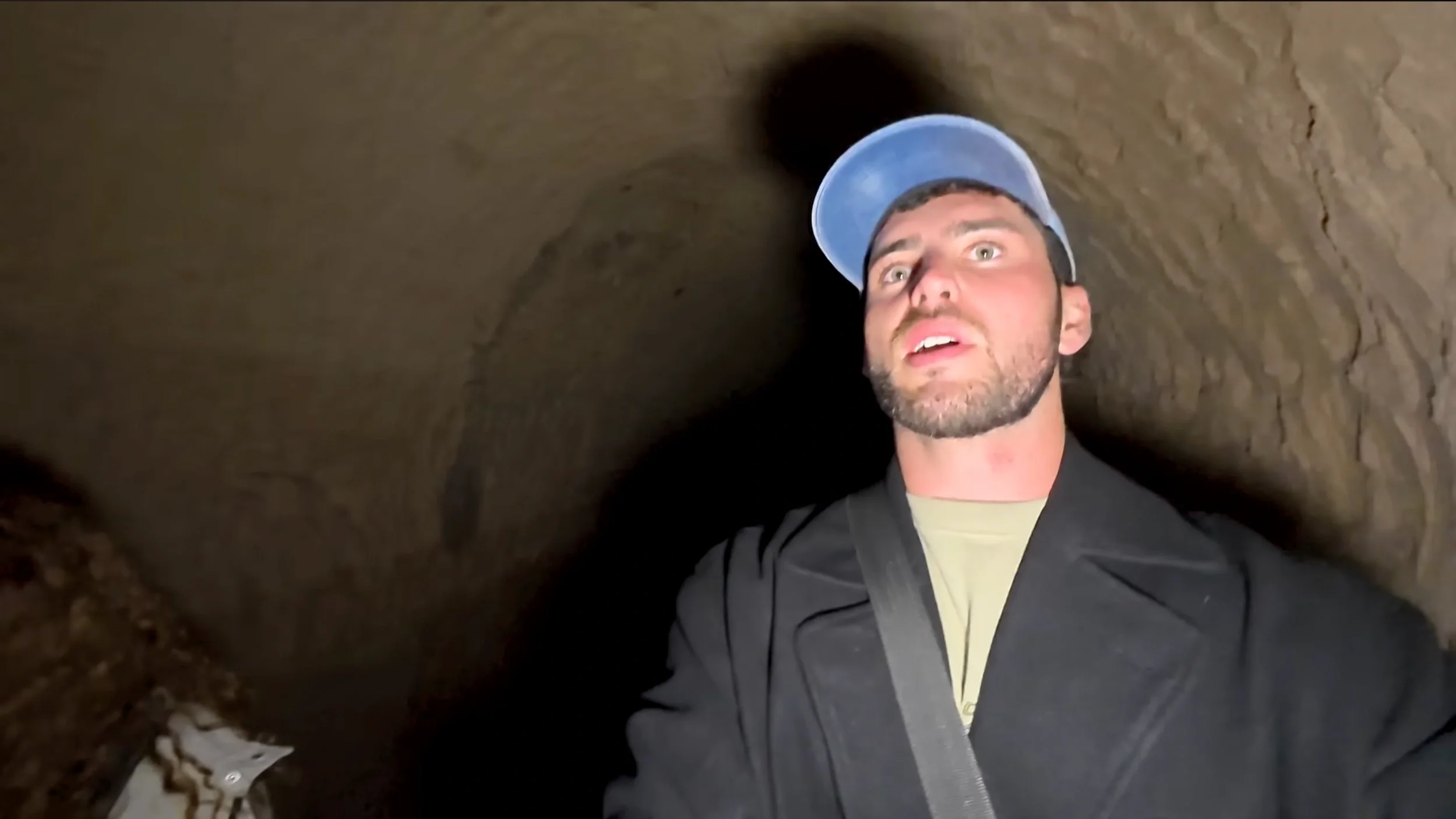
I was able to get inside one of the tunnels, which in hindsight was both the coolest and most questionable decision of the trip. I am not someone who loves the idea of being inside a collapsing underground passage where the infrastructure has been slowly eaten alive by years of rain, neglect, and the weight of everything above it.
I went anyway.
I was joined by my Syrian friend Rita, who told me about the man who started digging these tunnels. He was 13 years old when he picked up his first shovel. Assad's forces had killed both his parents. His mother died in his arms. And so he went underground, literally, and spent years of his life building the infrastructure of a resistance that held one of Damascus's suburbs for nearly a decade against one of the most well-armed governments in the region.
Standing in that tunnel, knowing that, changes how it feels to be there. The walls have cracks running through them. The ceiling shifts when it rains. Water has been finding its way in for years. It is dark in a way that feels heavy rather than just absent of light. And yet people lived down here. Fought from here. Buried their dead and kept going from here.
What Assad Bombed First
Near one of the tunnel exits there was a mosque. When the resistance surfaced, they would pray there and go back down. Assad found out. So he bombed it. Not as part of a broader strike, but specifically, deliberately, because people were praying there between shifts in the tunnels.
He bombed a girls' school too. Then the surrounding streets, then the homes, then the architecture that had been standing for hundreds of years, pre-Ottoman buildings and ancient synagogues flattened alongside everything else. The destruction was not random. The pattern of it tells you something about the intent behind it.
The most concentrated destruction came in waves across 2012, 2014 and 2016. Then in 2018, Assad and Russia gave the remaining population an ultimatum: leave, or we finish what is under the ground too. By that point the resistance had been ground down by years of chemical attacks, starvation, and sheer attrition. The remaining people were loaded onto green buses and shipped to Idlib in the north, a city that had become a holding ground for everyone Assad had defeated and expelled.
They had no idea what that city was about to become.
Seeing the Scale of It from the Top of a Building
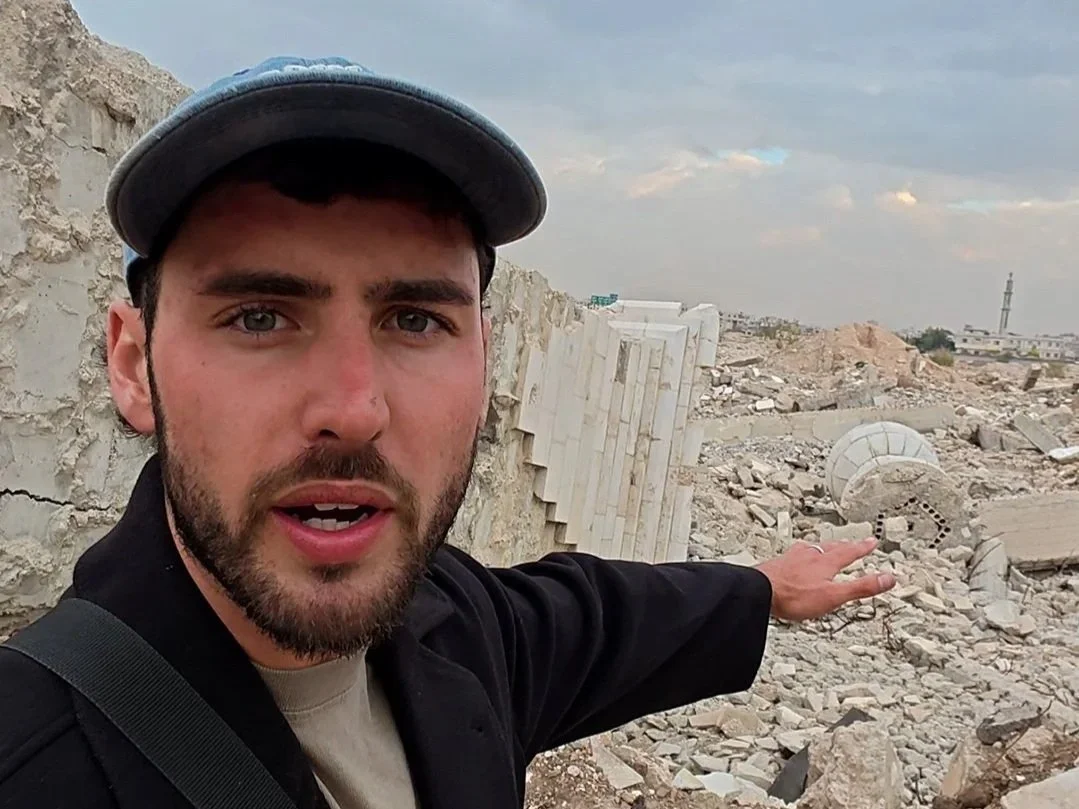
I climbed up into one of the buildings near the road to get a proper sense of the scale. Half a kilometre of destruction in one direction. Hundreds of metres in the other. A highway cutting through the middle that people still use every day, driving past all of it without stopping, because at some point you have to.
Some of the buildings closest to the road have kept fragments of themselves intact. Tiles still on the floor. Wiring still hanging from the walls. You can almost see the apartment it used to be, the room that was a kitchen, the corner that had a couch in it. Almost.
The Russian involvement in Jobar is something I had not fully understood before visiting. Russian soldiers were embedded with Assad's forces here, teaching them how to operate and maintain aircraft, how to build bombs, how to coordinate aerial strikes. Russia ran political cover at the UN and kept Assad in power through the worst of it, blocking resolutions, providing weapons, giving him the time and protection he needed to do what he did to places like Jobar. When Assad finally fled, it was to Moscow. Russia sheltered him there.
But here is the thing about the people who were put on those green buses to Idlib in 2018. They were not happy about it. They were furious. They had held out for years and they were being expelled from their own homes. And then, in late 2024, the Syrian liberation started from that exact city. The people who had been forced there, the ones who had been holding out in tunnels and then crammed onto buses and relocated, were part of the movement that finally brought the Assad regime down. The resistance that started in Jobar in 2011 ended in Damascus in 2024. It just took a very long detour through Idlib to get there.
Playing with Kids among the ruins
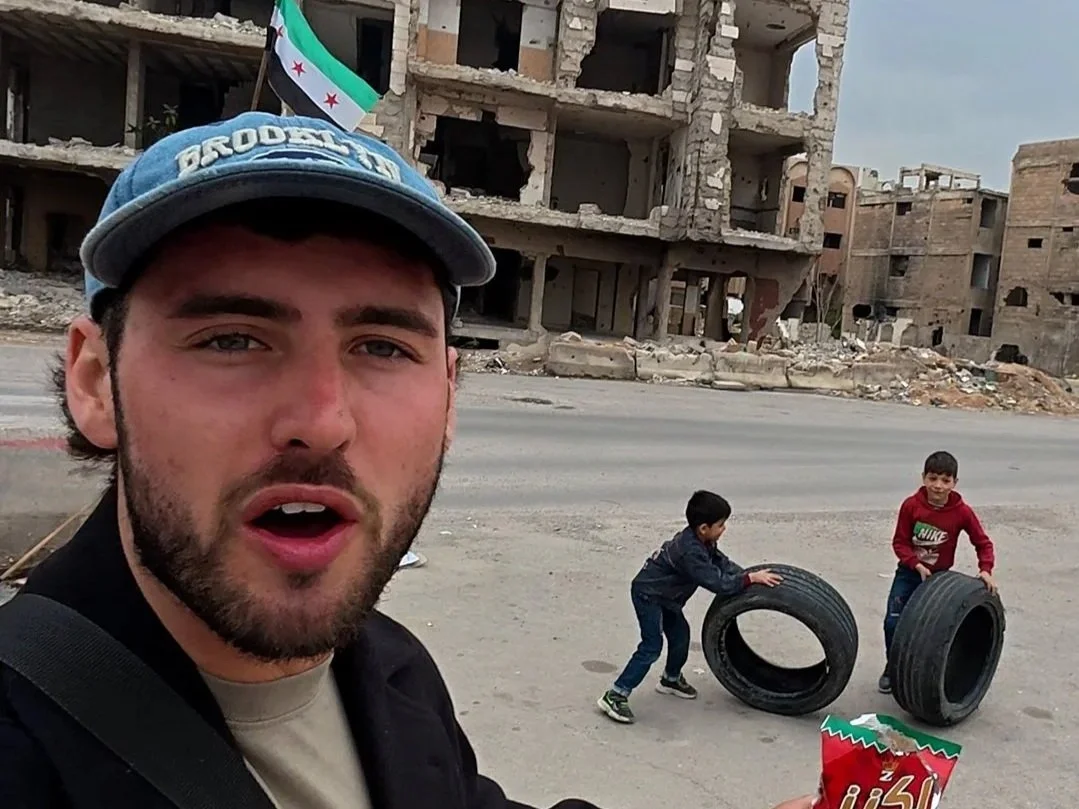
After walking around for a while we came across 2 boys who had set up a little shop among the ruins, selling chips and snacks from a small table. About 8 years old, though one of them did not actually know his own age. They come in every day with their uncle from a town in the Damascus countryside because the family lives elsewhere now.
These are the moments that stay with me. I am aware of how fortunate I am to be able to do what I do and see the world. But for a lot of people, when they finally do get to see more of the world one day, it is also when they realise they never really got to have a childhood. That is a strange thing to process while standing in a ghost city with 2 kids who are selling crisps in the rubble where 100,000 families used to live.
Because of the sanctions, Syria has been producing its own version of everything for years, so I tried the Syrian chips. Excellent, actually. Twisty little pasta-shaped things, slightly vinegary, crispy, different sizes all in the same bag. I gave them a solid rating.
I noticed the kids were playing with tyres nearby, so I joined in. The game was simple: each person gets a tyre, first to push it to the end line wins. I won. I am aware they were children so there is nothing to brag about, but I still gave it my best because I genuinely could not lose my first Syrian tyre race. Some things matter.
We spent some time after that talking with their uncle, and at some point it became clear we had stayed longer than intended. We started making our way back out, which turned out to be more complicated than expected.
We got properly lost. Not "took the wrong turn" lost, but more like "it is getting dark, there are reportedly extremists in this area, there may be landmines, and I genuinely cannot see a way out" lost. The landmine detail came up about halfway through the visit, which was a timing I appreciated enormously. Nothing like finding out there might be explosives in the ground after you have already been wandering through rubble for two hours in the wrong shoes.
Eventually we spotted a guy with a motorcycle, and hitchhiked back. Three people, no helmets, through the streets of Damascus.
Final thoughts
I have been to a lot of places in 7 years of travel. I have seen poverty, conflict, and aftermath in more forms than I expected when I started. But Jobar sits in a category of its own, not because the destruction is the worst I have seen, but because of what the destruction represents. This was not a city that collapsed. It was a city that refused to give up, and was punished for it for almost a decade, and is now standing as permanent evidence of what that punishment looked like.
The 2 kids with the crisp stall among the ruins are going to grow up knowing that this is what their neighbourhood used to look like.
Jobar is not a tourist attraction and I want to be careful about how I frame it. But I do think there is value in showing up to places like this and trying to understand what happened, rather than looking away because it is uncomfortable. The people who lived here deserve to have their story told as accurately and as widely as possible. This is one small attempt at that.
If you ever find yourself in Damascus, go. It is 10 minutes away and it will stay with you a lot longer than that.
-
Need an eSIM when you travel? Check out Globie eSim →
Want daily emails from me? Sign up here →